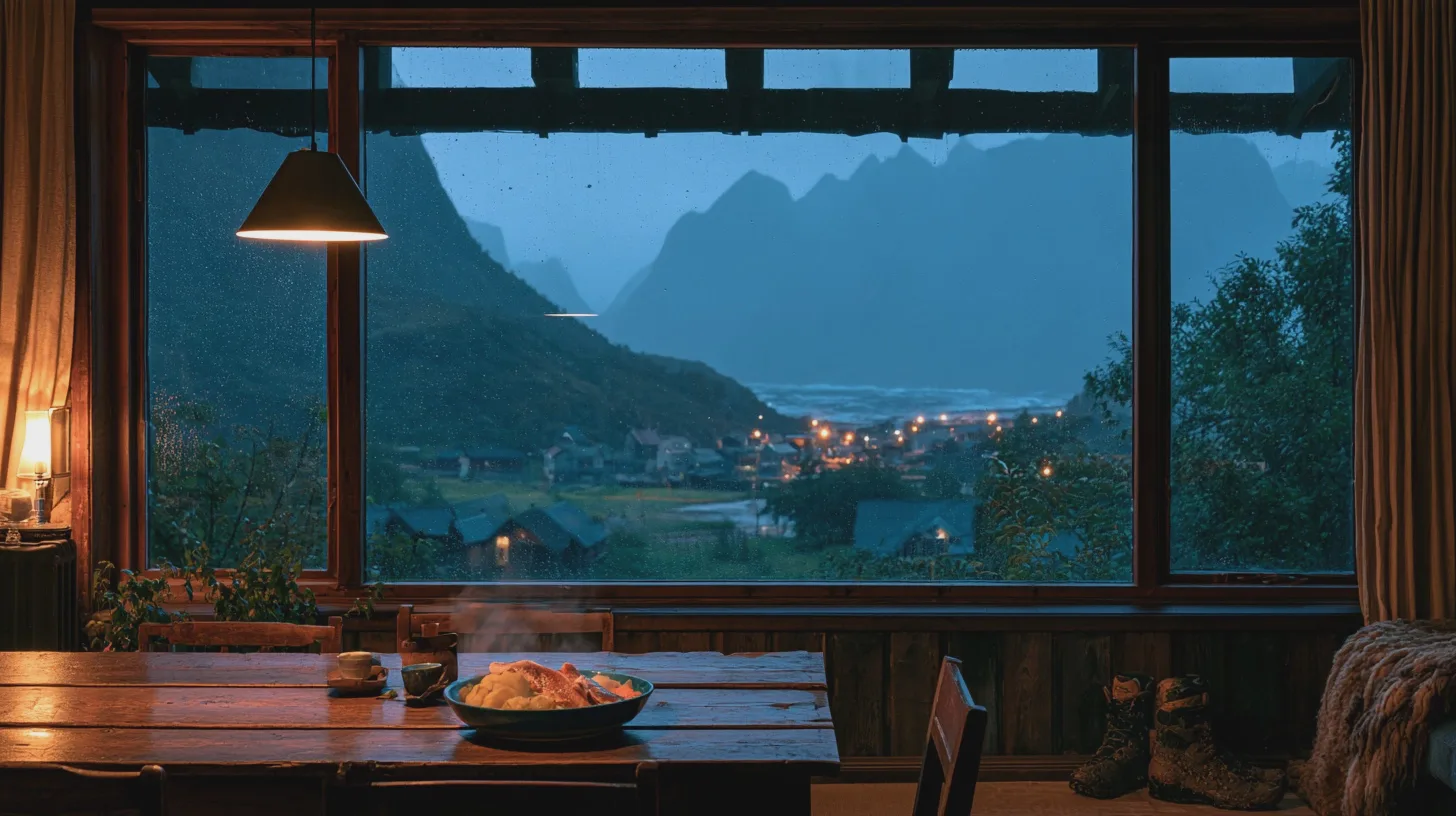
Norway’s Lofoten islands are at their most honest when the weather turns. A guide to the stockfish, the fishing villages, getting there from the UK and visiting without spoiling it.
Reviewed, edited and approved by Editor-in-chief Daniel Sköld · Updated 28 October 2026
Contents
Most places put up with their weather. Lofoten has spent about a thousand years putting it on the menu. The chain of granite islands off Norway’s north-west coast, well inside the Arctic Circle, built its wealth on cod hung out in the cold, dry wind until it went as hard as a cricket bat. That stockfish was traded down the coast to Bergen and on to Venice, Lisbon and beyond. The wind did the cooking. The fishermen just had to put up with it.
That’s why Lofoten makes most sense outside the postcard months. In summer, campervans queue on the single-track roads and the famous viewpoints get crowded. In the shoulder seasons and in winter, when the sea goes slate-grey and the drying racks fill with fish again, you see the place as it actually works. That’s when it starts to taste of something.
AD
Where is Lofoten and why does it matter to fish lovers?
Lofoten is in Nordland county in northern Norway, an archipelago that hangs off the mainland like a broken jaw. Its peaks rise almost straight out of the sea. Thanks to the Gulf Stream, the climate is much milder than you’d expect at this latitude, which is exactly what made it useful. Every winter the skrei, Arctic cod that live in the Barents Sea, swim south to spawn in the waters around the islands. The great Lofoten fishery has drawn boats here for centuries, and the season still runs roughly from January to April.
The catch is gutted, tied in pairs and hung on the A-frame wooden racks you see on every headland. It dries outdoors for about three months, with no salt and no smoke, until it keeps more or less forever. Stockfish from Lofoten now has protected status, and most of it still goes abroad. Italians in particular love it as stoccafisso. Venice’s connection supposedly goes back to Pietro Querini, a merchant shipwrecked on the outer island of Røst in the 1430s, who took the habit home with him.
Lofoten is one of the few places where the bad weather was never the problem. It was the business plan.
What should you eat in Lofoten?
Cod, obviously, but in more forms than you’d expect. In season, fresh skrei is often served as mølje: poached cod with its liver and roe, plus boiled potatoes. It’s plain and rich, and it’s the dish locals look forward to all year. Out of season, look for stockfish soaked back to life and served in stews, and for klippfisk, the salted and dried cousin that Portugal knows as bacalhau. Fish cakes and fish burgers are everyday comfort food. Anita’s Sjømat at Sakrisøy, near Reine, is a popular stop for both.
In Svolvær, the islands’ main town, Børsen Spiseri sits in an old fish-landing building on Svinøya. It has a solid reputation for traditional stockfish dishes. Lamb from the islands’ hill farms is worth ordering too, especially in autumn. Keep your expectations in proportion, though. Norway isn’t cheap, menus are short, and in the quieter months some places cut their hours or close altogether, so check before you drive half an hour for dinner.
Villages, museums and a Viking feast hall
Base yourself in a rorbu, one of the red or ochre fishermen’s cabins built on stilts over the water. Most have now been converted for visitors, some simply and some quite smartly. Henningsvær, spread across a cluster of islets, has galleries, cafés and a football pitch famously laid out on bare rock. Nusfjord is one of the best-preserved fishing villages in the country. Reine is the photogenic one, and everybody knows it.
At the far southern end of the road, in the village whose name is just Å, two museums tell the working story: the Norwegian Fishing Village Museum and the Lofoten Stockfish Museum, which is housed in an old landing station. The stockfish museum keeps short seasonal hours, so check before you go. Further north at Borg on Vestvågøy, the Lofotr Viking Museum has a full-size reconstruction of a chieftain’s longhouse built on the site of the original. It does a decent job of explaining why people bothered living out here in the first place.
AD
How do you get to Lofoten from the UK?
There are no direct flights from Britain. The usual route is London, Edinburgh or another UK airport to Oslo with Norwegian, SAS or British Airways, then a domestic flight north to Bodø. From Bodø you can take a short Widerøe hop to Leknes or Svolvær, or the car ferry across the Vestfjord to Moskenes. The crossing takes around three hours and can be lively in a westerly. Another option is to fly to Harstad/Narvik (Evenes) and drive in from the north. Hurtigruten’s coastal ships also call at Stamsund and Svolvær.
Book ahead outside the peak and a return from the UK to Lofoten typically comes to roughly £300 to £500, though summer and school holidays push that up. You’ll want a hire car, because buses are sparse and the scenery is mostly between the stops. Before you book, check the latest FCDO travel advice and entry requirements for Norway, and make sure your passport meets the validity rules. Norway isn’t in the EU, but a UK GHIC is accepted there for necessary state healthcare. It’s no substitute for proper travel insurance, though, and in a place where mountain rescue may mean a helicopter, that matters.
The Cornwall problem, Arctic edition
Anyone who has tried to park in Port Isaac in August, or followed a convoy of motorhomes round the North Coast 500, will recognise Lofoten’s dilemma. A few thousand residents now host vastly more visitors, mostly crammed into a short summer. Roads, car parks, toilets and popular hikes such as Reinebringen are under pressure. Local people have complained about wild camping in villages and walkers wandering into working fish yards.
The answer is the one Cornwall and the Highlands keep reaching for: come in a quieter season, stay longer, spend locally. September and October bring autumn colour, the return of the northern lights and far fewer people. Late winter brings the fishery itself, if you dress properly. Norway’s right to roam is generous, but it comes with obligations, so use campsites and proper toilets and take your rubbish with you. Never touch the fish on the racks. It isn’t scenery, it’s somebody’s income. If Newlyn’s working harbour or an Arbroath smokie has ever made you care where your fish comes from, Lofoten makes the same case on a much grander scale.
What it costs
Prices are approximate and will vary. A half-litre of beer in a bar or restaurant costs around NOK 110–140 (£8–£10). A typical dinner with a main course and a drink costs around NOK 500–700 per person (£37–£52). A short taxi ride of about 5 km comes to around NOK 250–350 (£18–£26), and taxis are scarce outside Svolvær and Leknes, so book ahead. Supermarkets are your friend, and a rorbu with a kitchen makes the bill far less painful.
In short
Lofoten, in Arctic Norway, is best understood through its fish: stockfish dried in the wind on wooden racks, and skrei cod landed from January to April. Get there by flying from the UK to Oslo, then on to Bodø, and continuing by Widerøe flight or ferry. Go in autumn or late winter, when crowds are smaller and the fishing villages are at work. Treat it the way you’d want visitors to treat Cornwall or the Highlands.
Archie Inglis writes about travel for men 45 and over: city breaks, winter sun, road trips, rail journeys, walking holidays and the longer trips you've been putting off. Where's worth going, how to get there without the hassle, and how to make the money go further.
One of Midcent's writers. Spotted something? Write to archie@midcent.uk.
Tallinn’s medieval Old Town gets the postcards, but a long weekend there is better spent in the harbour quarters, the 1928 public sauna and the craft breweries.
Smaller Alpine ski villages within easy reach of Geneva, Turin and Innsbruck, with quieter pistes, real village life, cheaper lift passes and the paperwork British skiers need.
Vietnam’s southern coast is dry when Britain is at its gloomiest, the soup is better than anything in the Canaries, and Britons can stay 45 days without a visa.
Albania’s Ionian coast has clear water, mountain passes and some of Europe’s oddest Cold War leftovers, all at prices that still make Mallorca look a bit greedy.