Clarkson’s Farm review: Prime Video’s best muddy surprise
Jeremy Clarkson swapped supercars for sheep at Diddly Squat, and Prime Video got its most likeable show. Five series in, here’s whether Clarkson’s Farm is still worth your evenings.
Reviewed, edited and approved by Editor-in-chief Daniel Sköld · Updated 24 October 2026
Contents
When I first heard that Jeremy Clarkson was going to run a farm on camera, I assumed it would be Top Gear with manure: a lot of shouting, a big tractor, and something catching fire by the third episode. To be fair, there’s plenty of shouting and the tractor is huge. What I didn’t see coming was that it would turn into one of the most honest programmes British television has made about where our food comes from.
Clarkson’s Farm started in June 2021 and is now on its fifth series. A man who has spent years saying he’s allergic to manual labour picked the most back-breaking job there is, and he lets the cameras film every humiliation. Somewhere along the way it stopped being a joke about Clarkson and became a show about British farming, with him as the punchline.
Premiere2021-06-11
GenreReality, Comedy
CastJeremy Clarkson, Kaleb Cooper, Charlie Ireland, Lisa Hogan
Seasons5 seasons · 40 episodes
ChannelPrime Video
Rated15
Watch onPrime Video
85%
AD
A Top Gear presenter, 1,000 acres and no idea
The premise couldn’t be simpler. Clarkson owns roughly 1,000 acres of the Cotswolds near Chipping Norton in West Oxfordshire. The farm is called Diddly Squat, which turns out to be a fair estimate of the profits. Rather than let someone else farm it, he decides to do it himself. The first series follows him through a year of crops, sheep, weather and paperwork, and it runs on the gap between how confident he is and how little he knows. Without spoiling much: buying a very large Lamborghini tractor to work some rather small Oxfordshire lanes tells you most of what you need to know.
Underneath the slapstick is a serious subject. British farming has been squeezed for years by rising costs for fuel, fertiliser, feed and machinery. Since Brexit there’s been the slow, nervy wind-down of the old Basic Payment Scheme and the move to Environmental Land Management schemes, which pay farmers for environmental work rather than for the land they hold. Then there’s the planning system. It famously refused Clarkson permission for a restaurant in series two, and in 2024 the rules on converting unused farm buildings were relaxed in what’s now nicknamed the Clarkson’s clause. Few telly programmes have changed actual policy. This one did.
The real stars wear wellies
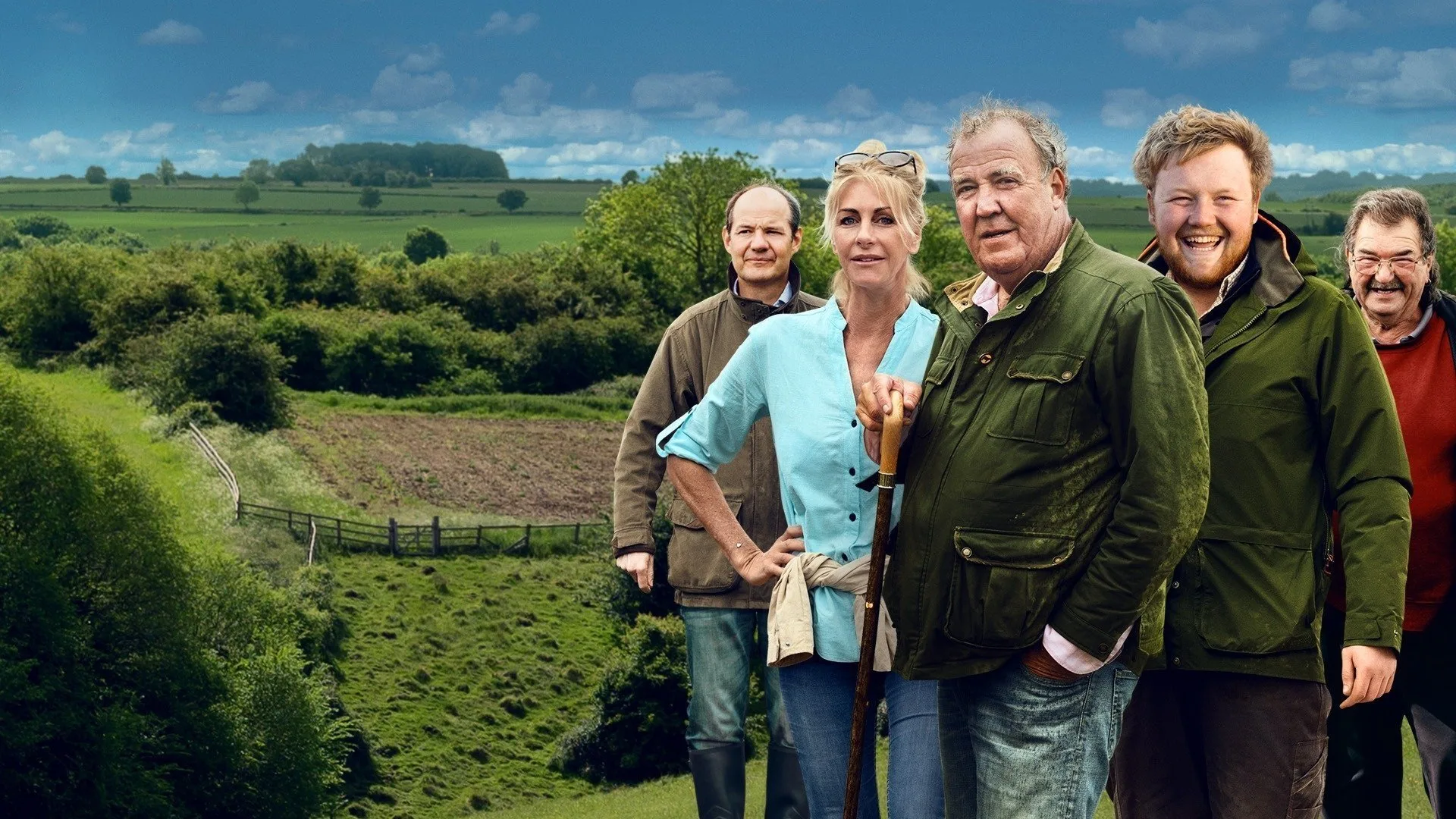
Clarkson narrates and leads, but anyone who’s watched it will tell you the show belongs to the people around him. Kaleb Cooper is the young local contractor who treats his boss with open contempt, rarely travels further than Chipping Norton and can do in ten minutes what takes Clarkson a week. Their double act is the beating heart of the show. Charlie Ireland is the farm’s long-suffering adviser, who arrives with spreadsheets and bad news in about equal measure. Lisa Hogan, Clarkson’s partner, runs the farm shop and quietly turns out to be the most competent person there. Then there’s Gerald Cooper, a dry-stone waller with an accent so thick that he sometimes needs subtitles, and a gentle charm that makes him a national treasure.
Behind the camera, the series is directed by Gavin Whitehead, Will Yapp and Kit Lynch-Robinson, and made by Expectation Entertainment and Con Dao Productions for Amazon MGM Studios. Episodes run from about 40 minutes to just over an hour. It carries a UK 15 rating, which is mostly down to the language. Kaleb doesn’t hold back, and nor does a ewe in labour.
It’s the rare reality show where the joke is on the rich man, and the farmers come out looking like the smartest people in the room.
AD
What works, and what’s starting to creak
The big achievement is the tone. The old Clarkson made a living out of sneering at people. Here, the locals who might once have been the butt of the joke are the experts, and he’s the idiot. It’s also beautifully shot. The Cotswolds look as lovely as a jigsaw box, yet the show never pretends the countryside is a postcard. You see lambs dying, harvests ruined by weather, and accounts that would make a pensioner weep. Once you’ve watched Charlie read out a year’s profit, you’ll never complain about the price of a loaf again.
The weaknesses arrive as the show ages. Once a format works, it can easily get comfortable. The later series lean more on Clarkson’s latest bright idea, whether that’s a restaurant, a car park or a pub, than on the farming itself, and the jeopardy can feel a bit staged. And you’re watching a very rich man for whom a bad year is a television storyline, not ruin. The show mostly knows this and occasionally says so, but it’s worth keeping in mind when the violins swell.
What the critics say
The critics have been unusually kind, which for a Clarkson project is a story in itself. On Rotten Tomatoes the first three series all score 100%, from small samples of reviews, and audience scores sit in the high 90s. Series four dipped to 88%. The Independent’s Nick Hilton called the show “at its heart, a bromance”, with Kaleb and Charlie replacing Hammond and May. In the Daily Telegraph, Anita Singh gave series two four stars and found it “thoroughly enjoyable viewing”. Reviewing series three, another Telegraph critic went further and claimed it had done “more for farming in a few episodes than Countryfile has in 30 years”.
Some reviewers have noticed the fatigue too. Vicky Jessop of the Evening Standard admitted that series three was “more of the same” but enjoyed it anyway, then gave series four three stars. The Independent’s Adam White praised the show as well made and “not Monty Don-gentle”, a description I can’t improve on.
Where to watch Clarkson’s Farm in the UK
Every series of Clarkson’s Farm is on Amazon Prime Video in the UK. That’s five series and 40 episodes so far, starting with the premiere on 11 June 2021. You need a Prime membership or a standalone Prime Video subscription. If you’ve never watched it, start at series one. The early episodes, with Clarkson learning which end of a sheep is which, are the funniest. They also explain the economics everything else depends on.
Verdict
Clarkson’s Farm is the best thing Jeremy Clarkson has done since Top Gear, and it might be the most useful thing he’s ever done. It’s funny, surprisingly touching and genuinely informative about the state of British farming, though the later series rely a bit too much on familiar tricks. It’s ideal for anyone who’s ever wondered why milk costs what it does, enjoys watching a millionaire get beaten by a sheep, or needs one more reason to keep paying for Prime. You don’t even have to like Clarkson. Kaleb will happily dislike him on your behalf.
Ashley Isaacs picks what's worth your evening – film, TV, streaming, music and books for men 45 and over with limited evenings and too many subscriptions. Reviews of what's new on Netflix, Prime Video, BBC iPlayer and the rest, crime dramas worth a weekend, and classics worth a second look. What's worth watching, what isn't, and where to find it in the UK.
One of Midcent's writers. Spotted something? Write to ashley@midcent.uk.
Thirty years on, Quentin Tarantino’s Pulp Fiction still gets quoted at the bar. Here’s why its dialogue holds up, what has dated, and where to stream it in the UK.
Mike Flanagan turns Stephen King’s Carrie into an eight-episode Prime Video series for the social-media age. Is a third trip to the prom worth it? Here’s my verdict.
Twenty-odd years on, David Chase’s mob drama still shows every prestige series how it’s done. Here’s why The Sopranos deserves a rewatch, and where to stream it in the UK.
Fifty years on, Spielberg’s Jaws still makes a paddle off Newquay feel risky. Here’s why the original blockbuster holds up and where to stream it in the UK.