Most people go to Amsterdam for the tulips, which means arriving in late April and sharing every bridge with them. March is the cleverer month. The city is coming out of winter, the canal houses aren’t hidden behind summer foliage, the brown cafés still have their stoves going, and a table for two is a reasonable thing to ask for.
March has one catch. The famous flowers are only just starting. Keukenhof, the big bulb garden near Lisse, opens in the second half of the month (in 2026 it runs from 19 March to 10 May). So a late-March trip gets you the first colour and the quieter city in one go, and you can let everyone else fight over Easter.

How do you get to Amsterdam from London by train?
Eurostar now runs direct between London St Pancras and Amsterdam Centraal in both directions, and the journey takes about four hours. Some services also stop at Rotterdam. You check in at St Pancras, go through passport control before you board, and get off in the middle of the city. The station sits on the IJ waterfront, a short walk from the canal ring. There’s no faff with liquids, no airport bus, and nobody makes you take your belt off.
If you book early and travel midweek, fares are often competitive with flying once you add the transfer to and from Schiphol. Flights from regional UK airports are still the quicker choice if you live in Manchester or Edinburgh. Driving via the Channel Tunnel or the Harwich–Hook of Holland ferry works for a longer trip, but Amsterdam punishes cars. Park at the edge of the city and leave the car there.
Before you go, check the latest FCDO travel advice for the Netherlands. The EU is changing its border checks for British visitors, so look up the current entry requirements. Check that your passport meets the Schengen rules on issue date and validity, take your GHIC for state healthcare, and buy travel insurance anyway. The GHIC doesn’t cover everything.
Is March a good time to visit Amsterdam?
Yes, if you pack for it. Expect daytime temperatures in single figures or the low teens, a fair amount of drizzle and wind coming off the IJ. That’s also the reason the city feels more like a place people live than a theme park. Hotel rates are usually lower than in the spring peak, and the big museums are easier to see properly. You still need a timed ticket for the Rijksmuseum, the Van Gogh Museum and the Anne Frank House. Book Anne Frank weeks ahead whatever the month.
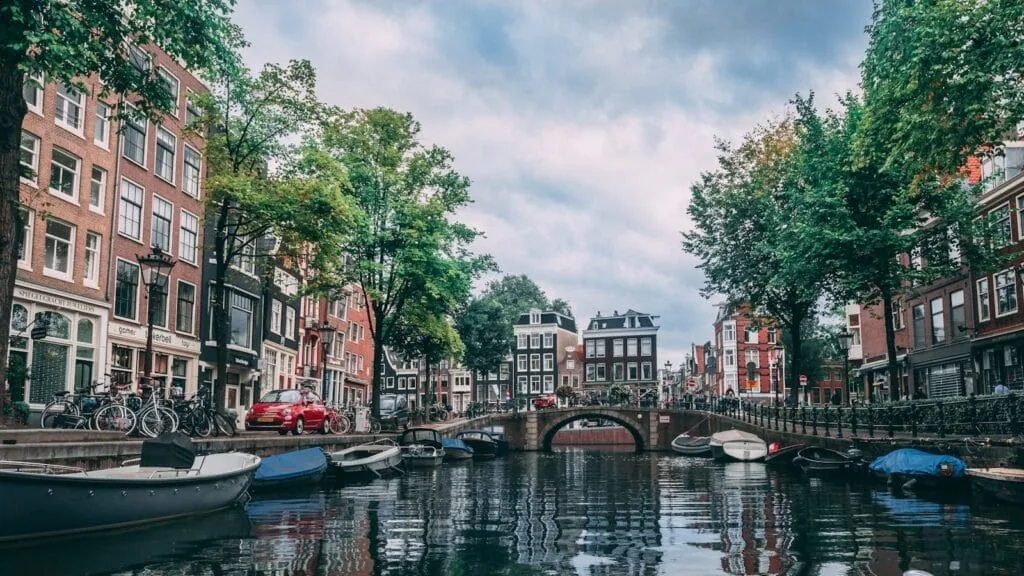
The canals are better in this light too. The Canal Ring has been a UNESCO World Heritage Site since 2010, and in March you can see the gables, hoist beams and lopsided façades without leaves in the way. Skip the big glass-roofed tour boats that leave from opposite Centraal with a recorded commentary. Look for a small open boat run by a local skipper. Several give out blankets in the cooler months, and they can get into the narrow side canals of the Jordaan and the Western Islands, where the big boats don’t fit. An hour is enough. If it’s raining hard, take the covered boat and don’t mind the people who sneer at it.
The tulips get the postcards, but Amsterdam is best before it has dressed up for visitors.
When should you go to Keukenhof to see the tulips?
Keukenhof is about 40 km south-west of Amsterdam. It’s open for only about eight weeks each spring and plants millions of bulbs for the season. The gardens are planted in layers so that something is always flowering. In late March you’ll mostly see crocuses, hyacinths and daffodils, with early tulips in the warmer beds and the indoor pavilions. The tulip display usually peaks around mid-April, as do the commercial bulb fields around Lisse, which are what most people actually want to photograph. Nature runs to its own timetable, though, and a cold March can push everything back by a week or two.
Here’s my rule of thumb. If seeing tulips is the whole point, go in April, on a weekday, and get there at opening time or late in the afternoon. If you want a city break with some flowers, go at the end of March and treat Keukenhof as a bonus. Either way, buy tickets online in advance and check the opening hours on the official site. Buses run to the park from Schiphol and from Leiden Centraal, and the easiest bus and entry tickets are sold together. A good alternative is to hire a bike near the entrance and ride the flat lanes between the fields. That’s where the stripes of colour are, and the lanes are much quieter than the paths inside the garden.
Not leaving the city? Amsterdam’s own Tulip Festival fills parks, gardens and courtyards with displays throughout April. The flower stalls of the Bloemenmarkt on the Singel sell bulbs all year, though check any bulbs you buy are certified for export before you carry them home.
Brown cafés and bars behind unmarked doors
Amsterdam’s best drinking happens in the bruine kroegen, the brown cafés, named for walls stained by centuries of tobacco smoke. Café Hoppe on the Spui has been pouring since 1670 and still has sand on the floor. ‘t Smalle on the Egelantiersgracht has a small canal-side terrace that’s lovely on a mild March afternoon. Then there’s Wynand Fockink, a tasting room down an alley behind Dam Square, which has been making jenever and liqueurs since 1679. Custom says your first sip is taken bent over the bar with your hands behind your back, because the glass is filled to the brim. Undignified, but traditional.
For something more hidden, Door 74 on the Reguliersdwarsstraat is the best-known of the city’s speakeasy-style cocktail bars: an unmarked door, low light and drinks made with great care. Book ahead. Otherwise, the bars in the Jordaan and De Pijp are where locals actually go. Keep away from the Red Light District after dark unless you enjoy watching stag parties try to find their hotel.
What it costs
Amsterdam isn’t cheap, and the tourist tax on hotel rooms, now 12.5 per cent, is among the highest in Europe. Rough prices:
Beer: the Dutch drink small glasses, so a 25cl pilsje in a brown café costs around €4–5 (about £3.50–£4.30). A pint-sized glass, where you can get one, costs €7–8 (£6–7).
Dinner: allow €35–50 (£30–43) a head for two courses and a glass of wine somewhere decent. The Indonesian rijsttafel is the classic splurge, and it’s worth doing once.
Taxi: a 5 km ride on the regulated meter comes to roughly €20–25 (£17–21). Trams are cheaper, you can tap in with a contactless card, and you can walk most of the centre in 30 minutes anyway.
In short
March is a smart time to visit Amsterdam: the Eurostar from St Pancras takes about four hours, the city is calmer and cheaper than in April, and the canal houses look their best before the trees come into leaf. If you want peak tulips, go to Keukenhof in mid-April on a weekday. If you’d rather have the quieter city with a bit of early colour, go in the last week of March, when the garden has just opened, and spend your evenings in a brown café.
Sources

Midcent Travel
Archie Inglis writes about travel for men 45 and over: city breaks, winter sun, road trips, rail journeys, walking holidays and the longer trips you've been putting off. Where's worth going, how to get there without the hassle, and how to make the money go further.
One of Midcent's writers. Spotted something? Write to archie@midcent.uk.