There’s a stage of fatherhood nobody warns you about. The children have grown up and turned out quite interesting, and just then everyone else wants their time too. Bosses, partners, in-laws and eventually grandchildren all lay claim to the same few weeks of annual leave. The trip you keep calling “one day” has an expiry date, and you probably won’t see it coming.
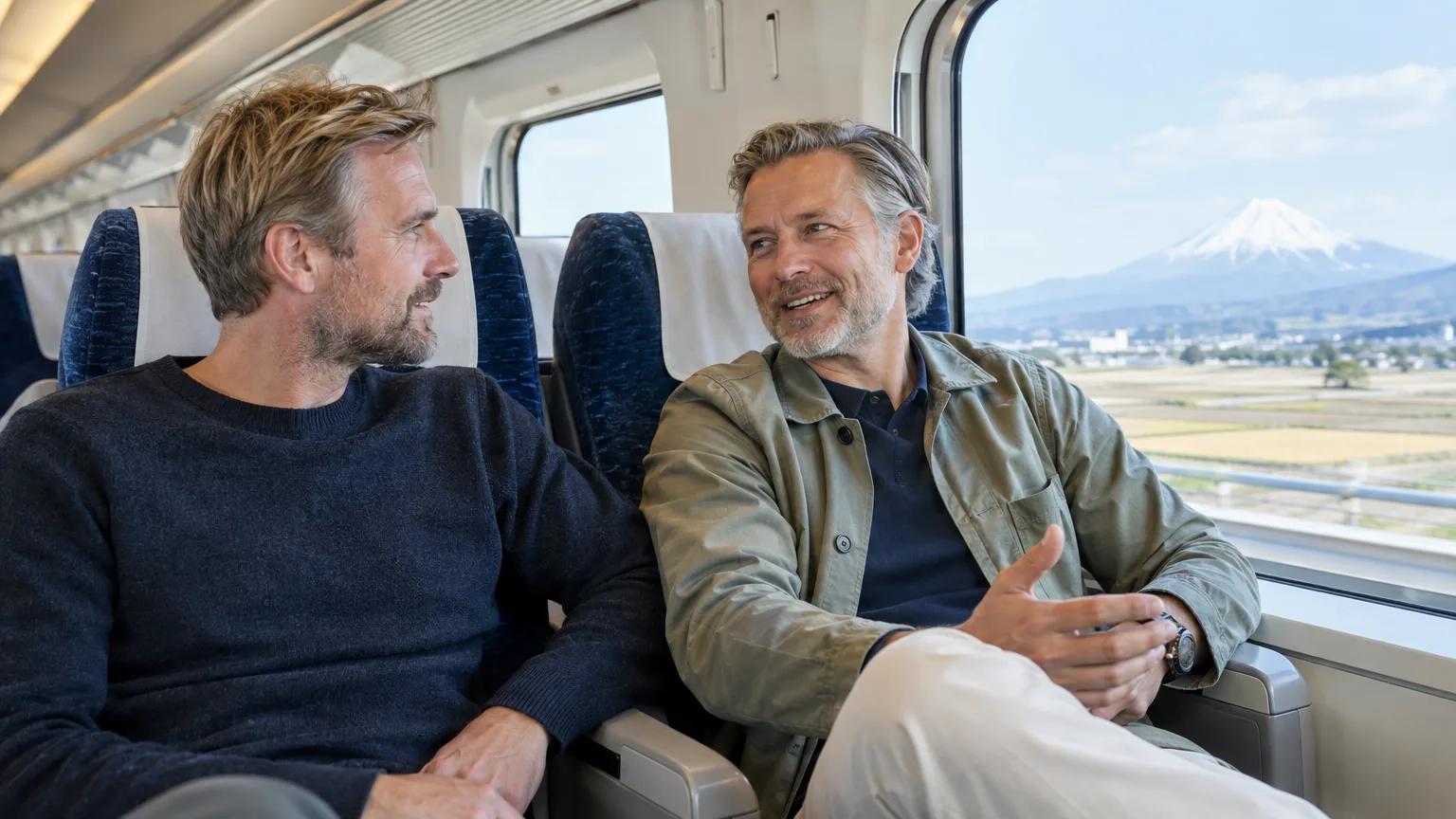
Japan by train is my case for booking it now. A shinkansen doesn’t rush anybody. There’s no driving, no navigator, and nobody has to leave for a taxi. You get two and a half hours between Tokyo and Kyoto with a bento box on the tray table and your eldest finally telling you what their job actually involves.

Why a train and not a beach?
A beach holiday with adult children slides into everyone on their own sunlounger, earbuds in. A road trip means one person drives, one navigates and someone sulks in the back. A train puts you side by side, facing the same window, with nothing to do for hours but look out and talk. Plenty of men find it easier to have a proper conversation side by side than across a table. A Japanese rail journey gives you that for a week or two.
Japan also suits a mixed group. Your 28-year-old gets the neon, the vintage shops of Shimokitazawa and late-night ramen. You get the gardens of Kanazawa, the temples of Kyoto and the sobering Peace Memorial Museum in Hiroshima. Everyone gets food that’s very hard to have a bad meal of. The trains are clean and punctual and don’t make a fuss about it, so nobody has to be the tour leader.
A sensible loop takes ten days to a fortnight. Go from Tokyo to Kanazawa on the Hokuriku line, then down to Kyoto. Take a day trip to Nara, carry on to Hiroshima and the island of Miyajima, then come back through Osaka for a last night of excess in Dotonbori.
The shinkansen doesn’t care who’s paying. For two and a half hours you’re simply three adults looking out of the same window.
How much does a Japan Rail Pass cost, and is it still worth it?
The nationwide Japan Rail Pass gives unlimited travel on most JR trains, including the bullet trains. The price went up sharply in 2023, and the standard-class adult price at the time of writing is about ¥50,000 for seven days and ¥80,000 for 14 days. Some overseas agents have announced further rises from October 2026, to about ¥53,000 and ¥84,000. At roughly ¥190–¥200 to the pound, a seven-day pass works out at about £250–£280 each and a 14-day pass at about £400–£440. Exchange rates move, so check before you buy.
The pass is no longer an automatic win. If you’re only doing Tokyo to Kyoto and back, separate tickets will usually cost less. It pays off if you add longer legs such as Hiroshima, Kanazawa or further north. Price up your route with single tickets before you commit. Since 2023 you can also use the fastest Nozomi trains on the pass by paying a supplement, which used to be off-limits.
One tip saves arguments. Large suitcases need a reserved space on the main Tokyo–Osaka bullet train line. Better still, use Japan’s cheap luggage-forwarding services to send bags ahead to the next hotel and travel with a day pack. It’s the closest thing to civilisation I know.
How do you get from the UK to Japan?
From Heathrow, British Airways, Japan Airlines and ANA fly non-stop to Tokyo. Flights avoid Russian airspace, so allow about 14 hours outbound. Manchester has no direct flight, so northern families will usually change in Helsinki, a Gulf hub, Istanbul or a European hub. A good connection through Helsinki can take less time overall than the trip down to Heathrow and the wait there.
Fares swing wildly by season. Cherry blossom (late March to early April), Golden Week (late April to early May) and the British summer holidays push prices up hard. Book months ahead, keep an eye on the airlines’ own sites, and be realistic: this is the biggest single cost of the trip.
Before you go, check the latest FCDO travel advice and Japan’s entry requirements, and make sure everyone’s passport is valid for the whole stay. Your GHIC is no use outside the EU, so everyone needs proper travel insurance. Japan has strict rules on some common medicines, including certain decongestants, so check before you pack the medicine bag.
When can everyone actually get the time off?
This is the real logistics problem, and it gets harder every year. Full-time workers in the UK are entitled to 5.6 weeks of paid leave a year, which usually means 28 days including bank holidays. A fortnight in Japan takes a big chunk of that. A grown-up child with children of their own is tied to school holidays, and those differ around the UK. Scottish schools usually break up in late June, while England, Wales and Northern Ireland follow in July. Easter and October half-term are often the only realistic windows, and they’re also the most expensive.
The best months for Japan are spring and autumn. Autumn colours peak in Kyoto in November, and that falls in term time. So the honest advice is to go while you still can: before the grandchildren start school, or while your children are still early enough in their careers to take a fortnight off without anyone noticing.
As for who pays, most fathers I know cover the flights and the pass, and the children cover dinner at least once. That’s good manners, not charity.
What does a day in Japan cost?
Japan is better value than its reputation suggests, partly thanks to the weak yen. Rough prices:
A draught beer in an izakaya costs about ¥500–¥700 (£2.50–£3.50). A good dinner costs about ¥3,000–¥5,000 per person (£15–£25), and much less at a ramen counter. A 5km taxi ride in Tokyo costs about ¥2,000–¥2,500 (£10–£13). Hotels are where the money goes, so a family room or a ryokan with shared dinners can make better sense than three separate rooms.
Can’t afford Japan? Take the train anyway
The idea works on a smaller budget too. The Caledonian Sleeper from London Euston to Fort William or Inverness gives you a whisky in the lounge car, a night of rocking northwards and a dawn over Rannoch Moor. You get much the same conversations for a fraction of the price. Or take the Eurostar to Paris or Brussels and go on by rail to the Alps, Italy or Vienna with an Interrail pass. It’s still side by side, it’s still slow, and nobody has to leave early.

In short
A one- to two-week rail trip through Japan is a great way to get real time with adult children before work and families fill everyone’s diaries. Budget about £250–£440 each for a Japan Rail Pass (if your route justifies one) on top of long-haul flights from Heathrow or via a hub from Manchester. Book early around school holidays and annual leave, and check FCDO advice and insurance. If the budget won’t stretch, the Caledonian Sleeper or a European rail trip does much the same job.
Sources

Midcent Travel
Archie Inglis writes about travel for men 45 and over: city breaks, winter sun, road trips, rail journeys, walking holidays and the longer trips you've been putting off. Where's worth going, how to get there without the hassle, and how to make the money go further.
One of Midcent's writers. Spotted something? Write to archie@midcent.uk.