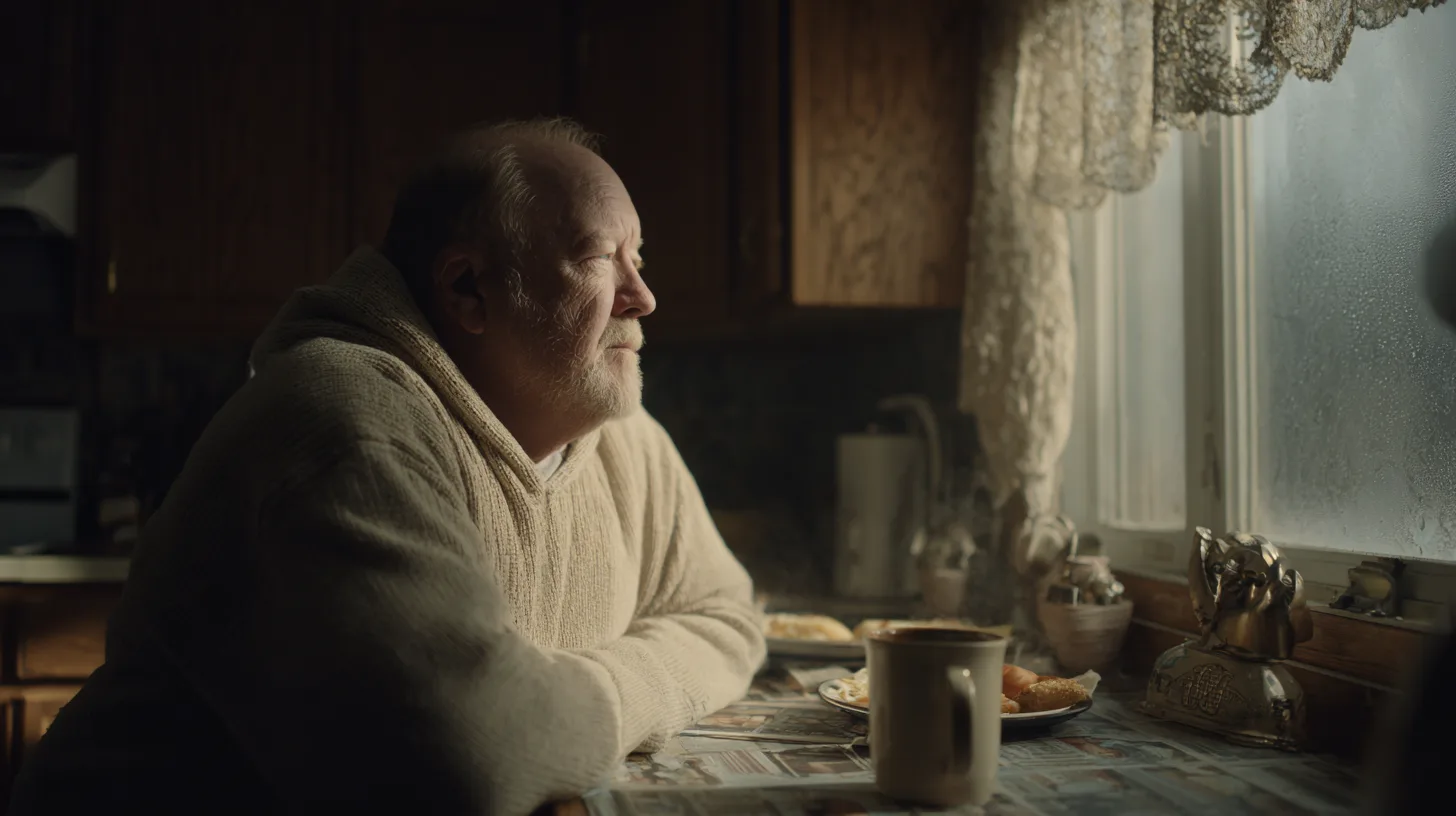
Picture a Tuesday evening in an ordinary British kitchen. One of you is scrolling through the news, the other is loading the dishwasher with a bit more force than it needs. Someone asks if there’s any milk. Someone says there is. That counts as the conversation for the night. Nobody has shouted and nobody has slammed a door. There is simply nothing going on between you, and it has been that way for a while.
That’s the silent divorce. It’s the marriage that ends everywhere except on paper. Plenty of men in their late forties and fifties are living in one right now. Many of them haven’t noticed, because when nothing goes wrong, it’s easy to assume nothing is wrong.

What is a silent divorce?
It isn’t a legal term, and you won’t find it on any form. It describes a couple who still share a roof, a mortgage and possibly a dog, but have quietly stopped being partners. You could call them housemates with joint finances. Nobody walked out. The relationship just ran down slowly, the way a car battery does over a long winter when nobody drives it.
Midlife is when the drift tends to show. For twenty years the children, the careers and the logistics fill every gap in the conversation. Then the youngest leaves, or at least stops needing a lift, and two people sit down at the kitchen table and find they’ve got very little to say to each other. You can talk about the boiler. You can talk about your mother’s hip. You can’t remember when you last talked about the two of you.
Divorce itself is common enough. The Office for National Statistics recorded 102,678 divorces in England and Wales in 2023. But those figures only count marriages that reached a courtroom. Nobody keeps count of the couples who never bother.
What are the signs your marriage is over but you still live together?
Arguing isn’t the main warning sign. Couples who argue still care enough to bother. It’s more worrying when the arguing stops because neither of you can be bothered any more. Watch for a few things.
First, your diaries no longer overlap and neither of you minds. You eat at different times, go to bed at different times and plan your weekends separately. When a shared evening comes up, it feels like an imposition.
Second, good news goes somewhere else first. You got the promotion, or the scan was clear, and you told a mate, a colleague or your sister before you told the person you live with.
Third, you’ve become very polite with each other. Being courteous is fine, but you’re starting to sound like a hotel concierge. Thank you for putting the bins out. No problem at all.
Fourth, the physical side has gone completely and nobody mentions it. Desire changes over a long marriage and that’s normal. What matters is whether you’ve agreed to say nothing about it.
Fifth, you picture the future and it doesn’t include them. You imagine retirement, the move to the coast or the long trip, and the other seat is empty. Pay attention to that one.
The loudest sign of a dead marriage is not the row. It is the silence where the row used to be.

Why men often miss it
Many men of our generation were raised to treat a quiet house as a successful one. If the bills are paid, the children are fine and there’s no shouting, the job is done. Feelings were something that happened to other people, mostly in EastEnders.
So the drift gets filed under being a bit busy at the moment, and the moment lasts about six years. Women file the majority of divorce applications in England and Wales, and one reason is that they often start the emotional exit earlier and plan it for longer. Men can be the last to know their marriage is over, even though they’ve been living in it the whole time.
There’s also the comfort of the routine itself. A silent divorce asks nothing of you. Nobody has to tell the children, sell the house or split the pension. Nothing is going on, and that makes it very easy to leave alone, so it can carry on for a decade.
Can a marriage come back from emotional drift?
Often it can, if you catch it before contempt sets in. The first step is the hardest, and it usually costs nothing: say something out loud. You don’t need a big speech. Keep it to an honest observation, along the lines of: I feel like we’ve become flatmates, and I don’t want that. Do you? Either answer is useful information.
After that, think about outside help. Relate is the best-known relationship counselling service in the UK and offers sessions in person, by phone and online. Fees vary by local centre and some offer reduced rates. You can go together or alone. Going alone is not an admission of defeat. Often it’s the only way the conversation starts.
If the drift has come with low mood, poor sleep, drinking more than you’d admit to the GP, or a general feeling that nothing much matters, go and see the GP. Sometimes the marriage is the problem. Sometimes it’s depression, and the marriage is what you notice first. In England you can refer yourself to NHS Talking Therapies without going through a GP. In Scotland, Wales and Northern Ireland, the GP is usually the starting point for psychological support.
Small practical changes help too. Eat together at the table without phones at least a couple of times a week. Do one thing every month that isn’t about the house, the children or money. None of it is glamorous, but marriages are mostly held together by ordinary habits like these.
And if it really is over?
Some couples talk it through and realise the kindest thing is to stop pretending. If that’s where you end up, know the rules, because they’re less daunting than many people assume and they vary across the UK.
In England and Wales, no-fault divorce has been in place since April 2022. Nobody has to blame anyone, and you don’t need to have lived apart first. If you’ve been married for at least a year, one of you or both of you together can apply online, saying the marriage has irretrievably broken down. There’s then a minimum 20-week wait before the conditional order, and a further six weeks before the final order. You can still be living under the same roof throughout.
Scotland works differently. Without blame, you need to have been separated for one year if both agree, or two years if one doesn’t. In Northern Ireland, the separation periods are two years with consent and five without, unless one of you relies on a fault-based fact such as behaviour or adultery. Before anything is filed, get proper advice on the house and pensions. For many couples in their fifties, the pension is the biggest asset they own, worth more than the house.
In short
A silent divorce is a marriage that ends emotionally while the couple carry on sharing a home, finances and routines. The signs are indifference rather than conflict: separate lives, good news shared elsewhere, polite distance and a future you picture alone. Naming it out loud, then trying Relate or speaking to a GP, can often turn things round. If it can’t be saved, England and Wales now allow no-fault divorce with no need to live apart first, while Scotland and Northern Ireland still require separation periods.
Sources

Midcent Society
Andy Irwin writes about the way we live now for men 45 and over: work, relationships, mental health, getting older, and the trends and debates that land on men in the middle of life. With the facts, a dry sense of humour, and no lectures.
One of Midcent's writers. Spotted something? Write to andy@midcent.uk.