Growing together and apart at the same time after 50
The children leave, parents need care, retirement looms and you both change. Here is why couples in midlife drift, what helps, and why some drifting is fine.
Reviewed, edited and approved by Editor-in-chief Daniel Sköld · Updated 27 October 2026
Contents
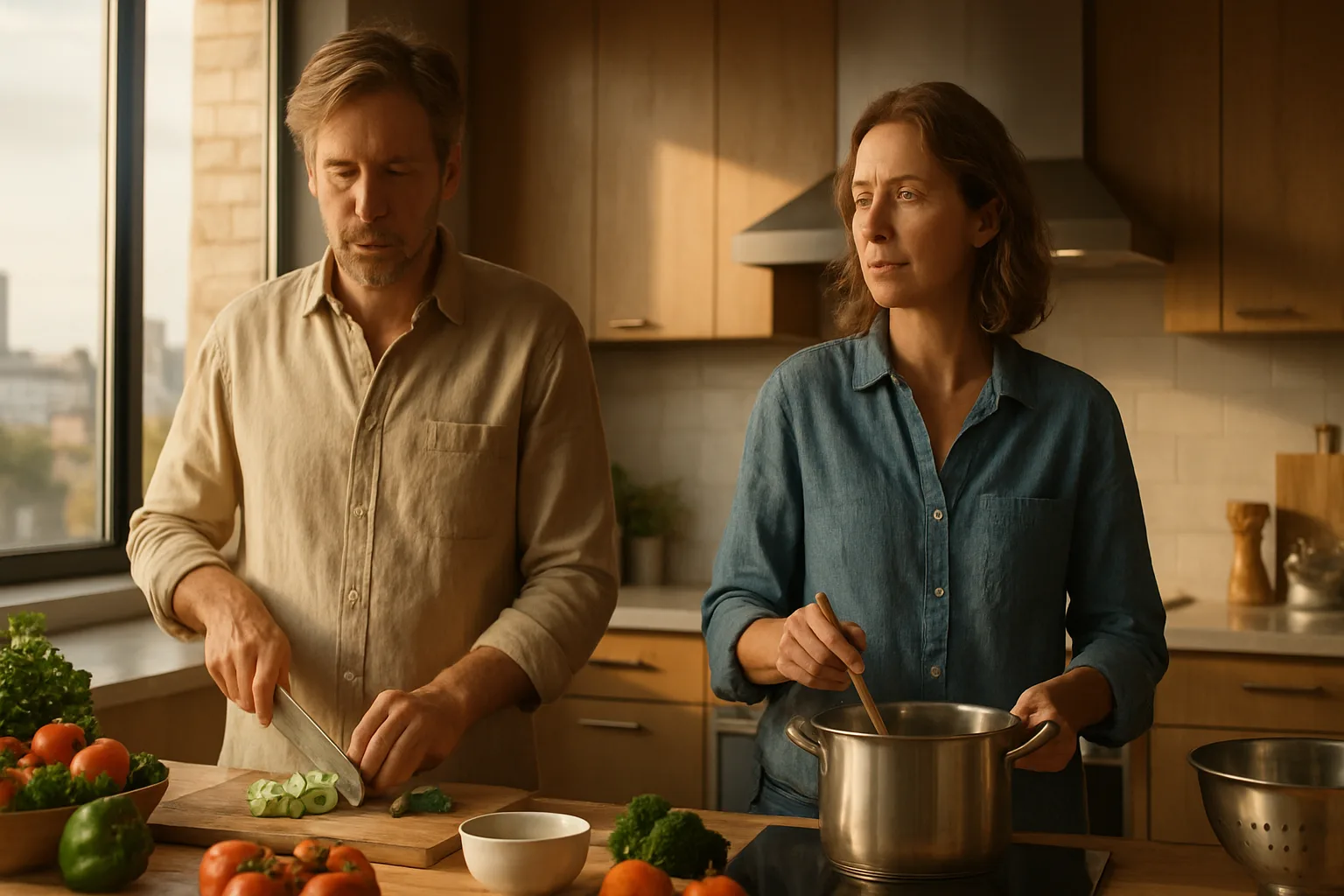
There’s a moment many long-married men will know. The last child has moved out (for now), the house has gone quiet, and you’re at the kitchen table with the person you’ve shared a mortgage, a car and roughly 9,000 dinners with. You realise you have no idea what she has been reading lately. She probably couldn’t name your new podcast either. Nobody did anything wrong, and it still feels a bit like a plot twist.
That’s the odd thing about being in a long relationship after 50. You are closer than ever in some ways: the shorthand, the shared history, the mutual tolerance of each other’s snoring. In other ways you are quietly heading in different directions. The real question isn’t whether that happens. It’s whether you notice in time.
AD
Why do couples drift apart after the children leave home?
For twenty-odd years most couples run as a logistics firm with a bed. School runs, parents’ evenings, who’s picking up whom from which party at 11pm. The children are the shared project, the main topic of conversation and, frankly, a convenient distraction. Take the project away and you find out what the relationship looks like without its main job.
The empty nest rarely happens in one clean go. Many British young adults now live with their parents well into their twenties, because rents and house prices see to that, and plenty bounce back after a break-up or a bad tenancy. So the house empties, fills and empties again. That stop-start pattern can postpone the reckoning without ever removing it. Then one day the spare room really is spare, and the two of you are left with each other and a lot of unscheduled Sundays.
Meanwhile you have both been changing. People don’t set in concrete at 40, whatever their teenagers say. One of you takes up running or a degree. Another finds church, cold-water swimming or a strong opinion about sourdough. Neither change is a threat in itself. The trouble starts when neither of you mentions it.
The squeeze from both ends
Just as the children loosen their grip, the parents often tighten theirs. Census 2021 figures from the Office for National Statistics showed that unpaid care is concentrated in late middle age, with people in their fifties among the most likely to be looking after someone. In practice that means drives up the M6 on a Saturday, phone calls with GP surgeries, and arguments about whether Dad should still be driving.
Caring pulls couples apart in very practical ways. Usually one partner, and it’s still more often the woman, takes on most of it. The other ends up as the supporting act, unsure whether to step in or keep out. Resentment builds quietly. One feels abandoned to the work, the other feels shut out of a family drama they can’t fix. And your own parent’s decline raises the questions nobody wants over dinner: is this us in twenty years, and who will do it for us?
Put those two pressures together, children leaving and parents declining, and it’s no surprise many couples feel like flatmates running a small care agency. The love hasn’t gone. It just hasn’t had much attention for a while.
AD
Does retirement make relationships better or worse?
Retirement is sold as the reward: long lunches, off-peak trains, finally doing the coast-to-coast walk. For some couples it is exactly that. For others it’s like two people who have run separate offices for thirty years suddenly sharing a desk.
Timing is the first problem. Couples rarely retire together, because ages, pensions and careers don’t line up. The State Pension age is 66 and is legislated to rise to 67 between 2026 and 2028, so even the official finishing line keeps moving. One partner can be at home rearranging the shed while the other still commutes and resents every cheery text about the garden.
Identity is the second. Many men of this generation have been their job. Take away the title, the team and the reason to put on a decent shirt, and there’s a gap that a spouse can’t be expected to fill on her own. Expecting the relationship to supply all the purpose, status and company that work used to provide is a lot to ask of anyone, however patient.
Growing apart isn’t the danger. Growing apart without saying so is.
Is grey divorce really on the rise?
The phrase is everywhere, so it’s worth keeping in proportion. The overall picture from ONS divorce statistics for England and Wales is not one of collapse. Divorce rates have been well below their early-1990s peak for years, and the bulletins show that a large share of divorces still end marriages that have lasted many years. Long marriages aren’t immune, but they aren’t doomed either.
What has changed is how easy it is to leave. Since April 2022, England and Wales have had no-fault divorce: one or both spouses can simply state that the marriage has irretrievably broken down, with no blame and no evidence of bad behaviour. Scotland has its own system, where divorce can be based on a period of separation (one year with consent, two without). Northern Ireland still relies on older rules, which means proving fault or a longer period of separation. Removing blame hasn’t made people leave on a whim, but it has made the exit less of an ordeal, which makes the question
In short
Growing together and apart at the same time is normal in a long relationship after 50: children leave, parents need care, retirement reshapes the day and both of you keep changing. The risk is not the drift itself but drifting in silence until you are strangers. Couples who say out loud what is changing, keep a separate life each as well as a shared one, and get help such as couples counselling early tend to come through it. So when did you last ask your partner what she wants the next twenty years to look like, and actually listen to the answer?
Andy Irwin writes about the way we live now for men 45 and over: work, relationships, mental health, getting older, and the trends and debates that land on men in the middle of life. With the facts, a dry sense of humour, and no lectures.
One of Midcent's writers. Spotted something? Write to andy@midcent.uk.
After 50, love is less about grand gestures and more about who remembers how you take your tea. That’s not settling for less. It might be the best deal going.
You share a house, a fridge and a Netflix login, but you stopped being a couple some time ago. How to spot a silent divorce, and what you can do about it.
The kids leave, the mortgage shrinks and the silence gets louder. Why divorce clusters in the mid-forties and fifties, and what men facing it need to know.
Separate bedrooms, a shared calendar and nothing else to talk about? How to tell when a marriage has quietly turned into a flatshare, and what to do before it’s too late.