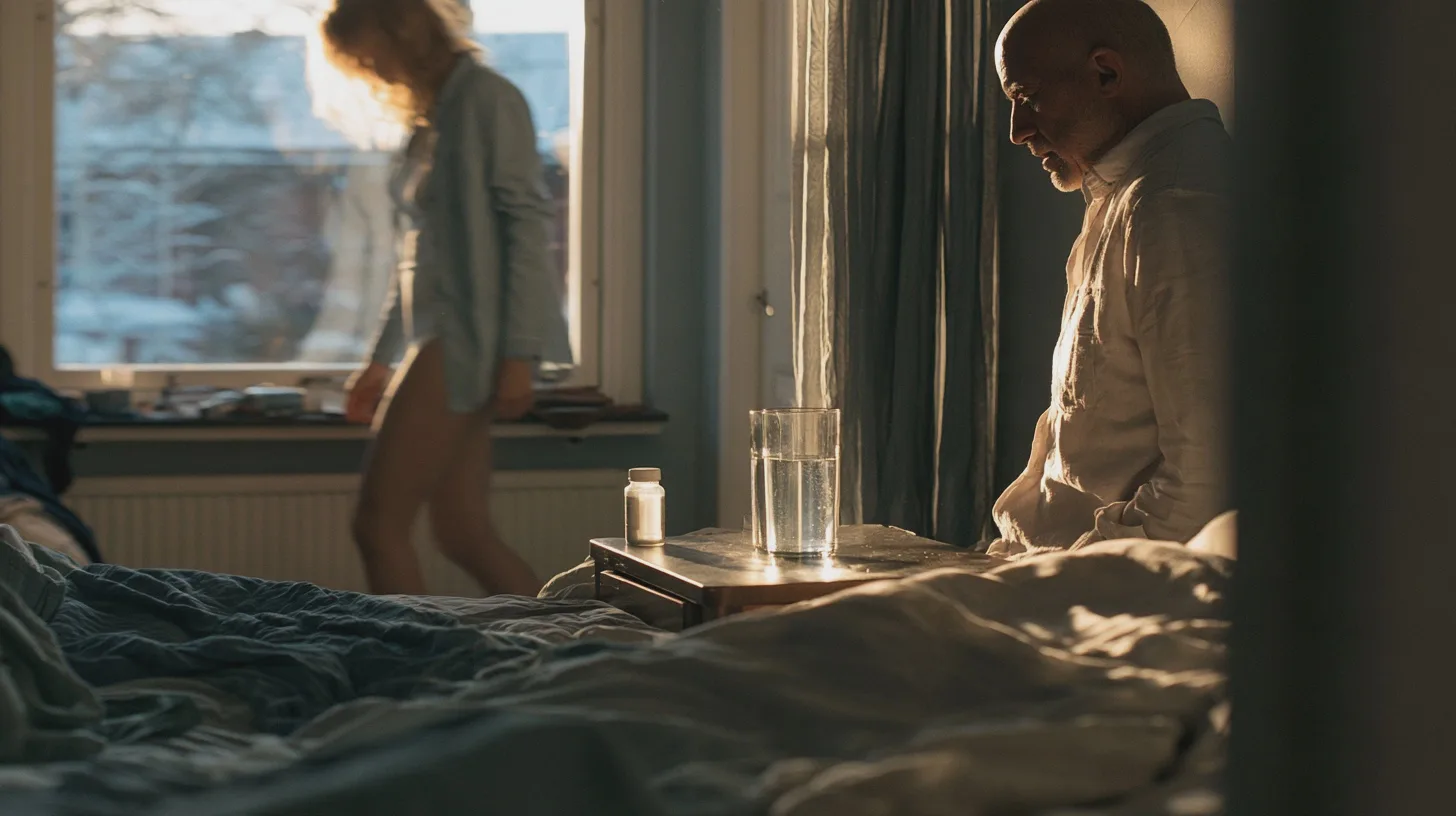
Antidepressants and your sex life: the side effect to raise
Millions of people in England take antidepressants, and many quietly lose their libido as a result. Here is what SSRIs and SNRIs can do, and what your GP can change.
Reviewed, edited and approved by Editor-in-chief Daniel Sköld · Updated 27 October 2026
Contents
Here is a conversation that happens in very few GP surgeries. The tablets are working. You’re sleeping better, you no longer feel like you’re wading through wet cement, and your other half says you’re nicer to be around. There’s just one problem: the bit of you that used to be interested in your other half seems to have left without a forwarding address. Nobody mentions it. Not you, and not the GP, who has nine minutes and a waiting room full of coughs.
A lot of men are having that non-conversation. Sexual side effects are among the most common reasons people quietly stop taking their antidepressants, often abruptly and often without telling anyone. That is a bad way to handle a problem that can usually be fixed.
AD
How many people in Britain take antidepressants?
More than most of us would guess. According to the NHS Business Services Authority, which tracks prescriptions dispensed in the community, 92.6 million antidepressant items went to an estimated 8.89 million patients in England in 2024/25. That was a rise of almost 4% on the previous year. The figures for 2025/26 have climbed again, to around 96 million items and 9.1 million patients. About 3.2 million of those patients are men.
That’s roughly one adult in five in England. Scotland, Wales and Northern Ireland publish their own prescribing data, so they aren’t in that total, but the pattern there is broadly similar. Women still make up about two-thirds of patients. Even so, 3.2 million men is a lot of blokes who are statistically unlikely to bring up their erections with a GP they last saw about a verruca.
Most of those prescriptions are for SSRIs (selective serotonin reuptake inhibitors) such as sertraline, citalopram, fluoxetine and escitalopram, or SNRIs such as venlafaxine and duloxetine. They are cheap, well understood and usually the first thing a GP reaches for. They are also the antidepressants most closely linked with sexual side effects.
Do SSRIs affect your sex drive?
Often, yes. The NHS lists sexual problems among the recognised side effects of SSRIs and SNRIs. These include a lower sex drive, difficulty getting or keeping an erection, and trouble reaching orgasm, or ejaculation that takes so long it stops being fun for anyone. Some men describe something harder to pin down: a general muting, as if someone has turned the colour down on desire itself.
The reason is fairly simple. Serotonin helps to steady your mood, but it also puts the brakes on the sexual response. Boost it, and you can damp down the dread and the libido together. It’s the same mechanism that makes some SSRIs useful for treating premature ejaculation, which tells you how much they slow things down.
Estimates of how many people are affected vary a lot, mainly because they depend on whether anyone actually asks. When patients are left to bring it up themselves, the numbers look small. When they’re asked directly, they are much bigger. And men in their late 40s and 50s face an extra complication, because ageing, blood pressure, diabetes, alcohol and depression itself can all hit sexual function. Low libido is a classic symptom of depression. Before you blame the pill, it’s worth asking whether you were in good shape before you started taking it.
Feeling better in your head and feeling nothing in bed shouldn’t be the price of treatment. It’s a side effect, and side effects can be managed.
AD
What if the problem doesn’t go away?
Some side effects, especially nausea and jitteriness, tend to ease after the first few weeks. Sexual ones are more stubborn, and for many people they last as long as they keep taking the drug.
There is also a rarer and more contested problem. Patient information leaflets for SSRIs and SNRIs in the UK now warn that sexual dysfunction can, in some cases, carry on after treatment stops. Patient groups call this post-SSRI sexual dysfunction, or PSSD. Nobody yet knows how common it is or exactly why it happens, and it’s important not to turn a rare outcome into a reason to fear treatment that may be keeping someone well. But you are entitled to know about it, and to have it taken seriously if it happens to you.
When should you talk to your GP or pharmacist?
As soon as it bothers you, and definitely before you do anything drastic. The one thing not to do is stop suddenly. Coming off SSRIs and SNRIs too quickly can cause discontinuation symptoms: dizziness, the electric-shock “brain zaps” many people describe, irritability, poor sleep and flu-like aches. It can also bring back the depression you were treating in the first place. Any reduction should be gradual and planned with a clinician.
A GP has several options. Some people can go down to a lower dose and keep the benefit. Another option is switching to a different antidepressant that is less likely to cause sexual problems. Mirtazapine and vortioxetine are among the alternatives sometimes considered, though each comes with its own trade-offs, mirtazapine’s being sleepiness and weight gain. Talking therapies are another route, and you can refer yourself in England through NHS Talking Therapies. And if the specific problem is erections, some men can carry on with an antidepressant that works for their mood and add a treatment for erectile dysfunction such as sildenafil. Since 2018 sildenafil has been available from pharmacies without a prescription after a consultation with a pharmacist.
Your community pharmacist is underrated here. They can tell you how your particular drug tends to behave and whether other medicines you take could make things worse. If it’s needed, they can also nudge you back towards the GP with the right question to ask. It is often easier to say “I’ve noticed a side effect” across a pharmacy counter than to dig it out at the end of a GP appointment.
A quick word on cost. Prescriptions are free in Scotland, Wales and Northern Ireland. In England you pay the standard charge per item unless you’re exempt, and men aged 60 and over get free prescriptions automatically. If you’re under 60 and paying for a monthly antidepressant plus anything else, a prescription prepayment certificate will usually save you money.
How to start a conversation nobody wants to start
Be specific, and be boring about it. “Since starting sertraline, I’ve had less interest in sex and trouble finishing. It’s affecting my relationship. What are my options?” That takes about twelve seconds, uses no euphemisms and gives the GP something to work with. Write it on your phone if that helps. Doctors have heard far worse before lunch.
And tell your partner. A lot of the damage done by antidepressant side effects isn’t pharmacological. It comes from silence: one partner assumes they are no longer wanted, while the other is too embarrassed to say it’s the medication. Five awkward minutes now beats five months of that.
In short
SSRIs and SNRIs, the antidepressants most often prescribed in Britain, commonly reduce sex drive, cause erection problems or delay orgasm, and these effects often don’t wear off by themselves. Don’t stop your tablets suddenly. Tell your GP or pharmacist plainly what’s happening, because lowering the dose, switching drug, adding talking therapy or trying an erectile dysfunction treatment can all help. Getting your mood back shouldn’t cost you the rest of your life, so the question is why so few of us ask.
Andy Irwin writes about the way we live now for men 45 and over: work, relationships, mental health, getting older, and the trends and debates that land on men in the middle of life. With the facts, a dry sense of humour, and no lectures.
One of Midcent's writers. Spotted something? Write to andy@midcent.uk.
Sexual side effects from antidepressants are common, rarely discussed and often fixable. What NHS guidance expects from your GP, and what to ask at your next appointment.
Men in midlife are experts at ignoring burnout until it flattens them. Here’s how to spot the warning signs, what your employer owes you, and where help actually is.
Middle-aged British men rarely fall out with their friends. They just stop ringing them. Here’s why male friendships fade after 45, and how a pint, a shed or an allotment can bring them back.