Reviewed, edited and approved by Editor-in-chief Daniel Sköld · Updated 30 October 2026
Contents
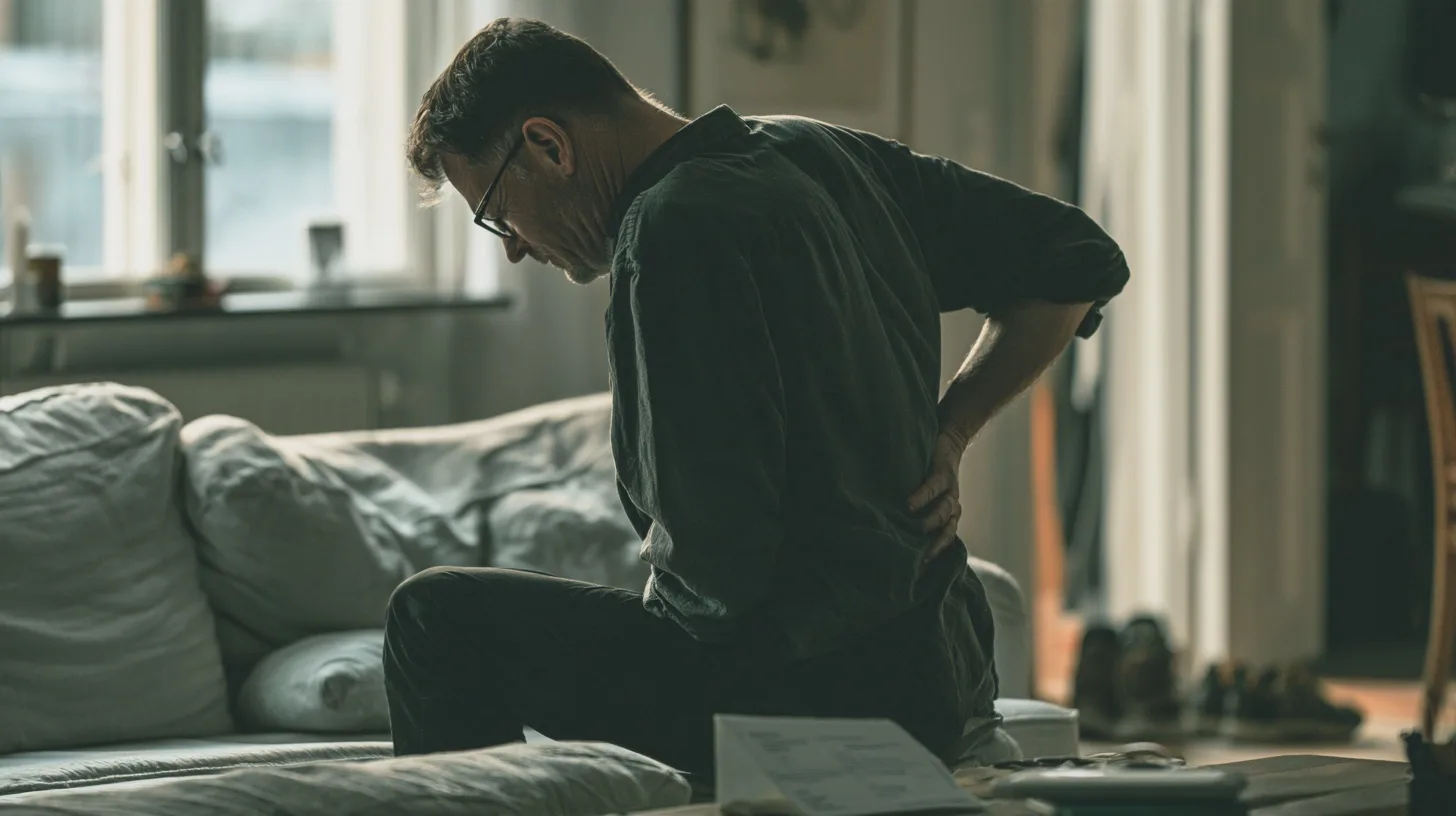
You bend to pick up a bag and your back objects as though you have attempted a deadlift with the fridge. At 50, it is tempting to blame your age, cancel your plans and search for a slipped-disc diagram.
Usually, none of those things helps. What matters is separating a painful but manageable flare-up from symptoms that need medical attention. The difference is not simply how loudly your back complains.
AD
Is this ordinary back pain or something more?
Lower back pain often starts after an awkward lift, an unfamiliar bit of exercise or no memorable incident at all. You might feel stiff getting out of a chair and more comfortable once you are moving. Most episodes improve within a few weeks, though the pain can return. A sore back does not automatically mean you have damaged your spine.
Pay attention to where the symptoms go. Pain that travels through your bottom and down one leg, perhaps with tingling, numbness or weakness, can be sciatica. It is worth taking seriously, particularly if it worsens or disrupts normal life, but sciatica on one side is not automatically an emergency. Pain in your back alone is not usually sciatica, however convincingly the internet has labelled it.
You do not need to work out which disc, muscle or nerve is responsible before you decide what to do. Notice what is changing instead: can you move about, are symptoms spreading, and have you developed problems with feeling, strength, your bladder or your bowels? Those answers are more useful than trying to name an injury from a picture.
Which back pain symptoms mean get help now?
Back pain with new loss of feeling around your genitals, inner thighs or bottom needs emergency assessment. So do new difficulties starting a wee, loss of bladder or bowel control, or not being able to tell when you need to go. New changes in sexual sensation or the ability to get an erection alongside back pain also matter. These can be signs of pressure on the nerves at the base of the spine. It is rare, but delaying assessment risks lasting harm.
Get emergency help if back pain comes with pain, tingling, weakness or numbness in both legs, or if it begins after a serious accident. Back pain together with chest pain also calls for emergency help. In England, Wales and Northern Ireland, go to A&E immediately for these warning signs, or call 999 if you cannot get there safely. Do not drive yourself. In Scotland, NHS inform advises phoning NHS 24 on 111 straight away for new bladder, bowel or saddle-area symptoms so you can be directed to emergency assessment; call 999 for a life-threatening emergency.
New bladder, bowel or saddle-area symptoms are not a ‘see how it feels tomorrow’ problem.
If you are unsure whether a symptom counts, seek urgent advice rather than testing it for another day. You do not need to be certain something serious is wrong before asking for help.
AD
When should you speak to a GP?
Ask for an urgent GP appointment if your back pain starts suddenly and severely, gets worse quickly, or comes with feeling feverish, shivery or generally unwell. In England, NHS 111 can advise if you cannot reach your GP; Wales has NHS 111 Wales, and Scotland has NHS 24 on 111. In Northern Ireland, contact your GP or your local GP out-of-hours service when the surgery is closed. There is no general NHS 111 service there.
Arrange a GP appointment if pain has not improved after a few weeks of looking after it, is stopping ordinary activities or is becoming hard to cope with. Do the same if you have unexplained weight loss, pain that is worse at night or does not ease with rest, or pain between your shoulder blades rather than in your lower back. Tell your GP if you have a history of cancer or other symptoms that worry you. These clues do not mean you have a serious condition; they mean the back pain deserves a proper assessment.
For straightforward ongoing back or joint trouble, physiotherapy may be an option. Many adults in England can refer themselves to a local NHS community musculoskeletal service, though availability varies by area and it is not a route for urgent symptoms. If you live in Scotland, Wales or Northern Ireland, ask your GP practice or local health service how to access physiotherapy. Do not let the prospect of a routine physio appointment delay urgent care.
The useful work starts with moving
If there are no warning signs, aim to keep doing manageable parts of your normal day. A gentle walk around the block, then a little more as you feel able, is more useful than staying in bed until your back feels perfect. Change position regularly if sitting makes you stiff. You need not prove your toughness by lifting the garden shed: ease back into heavier tasks rather than forcing them through sharp pain.
Heat wrapped in a towel may ease stiffness or muscle spasm; a wrapped cold pack may help a painful flare-up. Neither fixes an underlying cause, but relief can make it easier to move. Walking, swimming, yoga or Pilates may suit you once you are ready. Start at a level you can manage, and seek advice if an exercise makes your pain worse. There is no single magic stretch you have failed to discover.
Ask a pharmacist which pain relief, if any, is suitable for you. Anti-inflammatory medicines such as ibuprofen can help some people with lower back pain, but may be unsuitable if you have had a stomach ulcer, have heart or kidney problems, or take certain medicines, including blood thinners. NICE does not recommend paracetamol on its own for lower back pain. If pain runs down your leg, the benefit of anti-inflammatories is less clear, so it is especially worth discussing your options rather than reaching for a familiar packet.
If the problem persists, exercise-based support or physiotherapy may help you return to what matters, whether that is work, a round of golf or putting your socks on without a strategy meeting. NICE advises against routine scans for lower back pain or sciatica in non-specialist care; a scan is most useful when its result is likely to change treatment. Massage can be part of a plan that includes exercise, but it is not a substitute for rebuilding movement. The unglamorous approach is often the sensible one.
In short
Most back pain improves within weeks: keep moving gently, avoid prolonged bed rest and ask a pharmacist or GP about suitable pain relief. Seek emergency assessment for new bladder or bowel problems, numbness around the genitals or bottom, symptoms in both legs, or pain after a serious accident. Contact a GP if pain is worsening, comes with illness or does not improve.
Adrian Irving writes about health for men 45 and over who would rather do something than worry. Training, weight loss, sleep, cholesterol and blood tests, heart health, testosterone, the prostate, mental health and your sex life – what the evidence says, what's worth trying, and when it's time to see your GP.
One of Midcent's writers. Spotted something? Write to adrian@midcent.uk.
Weight-loss injections can reduce more than body fat. Here is what the evidence says about muscle loss, and how to protect your strength without living in a gym.