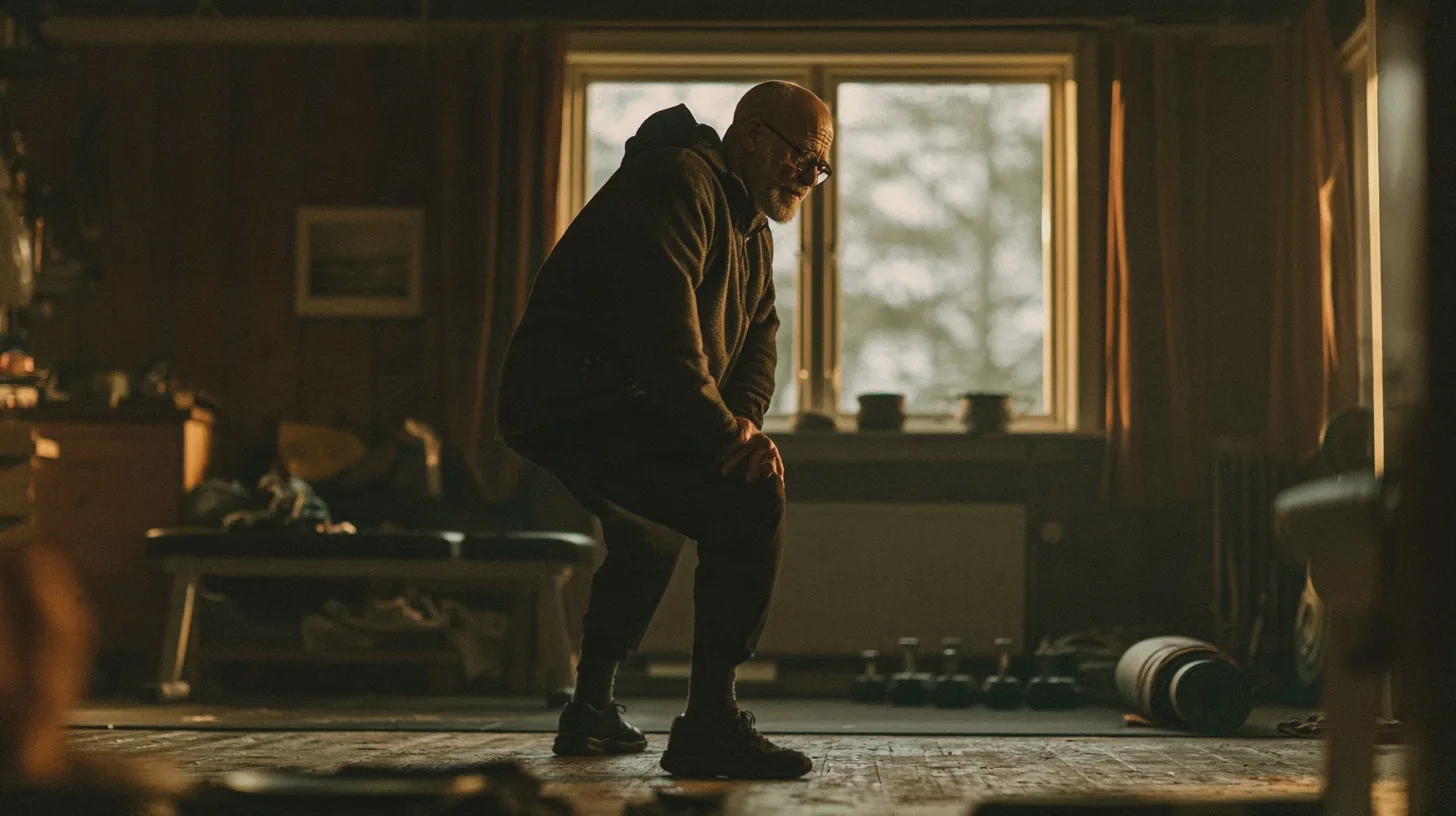
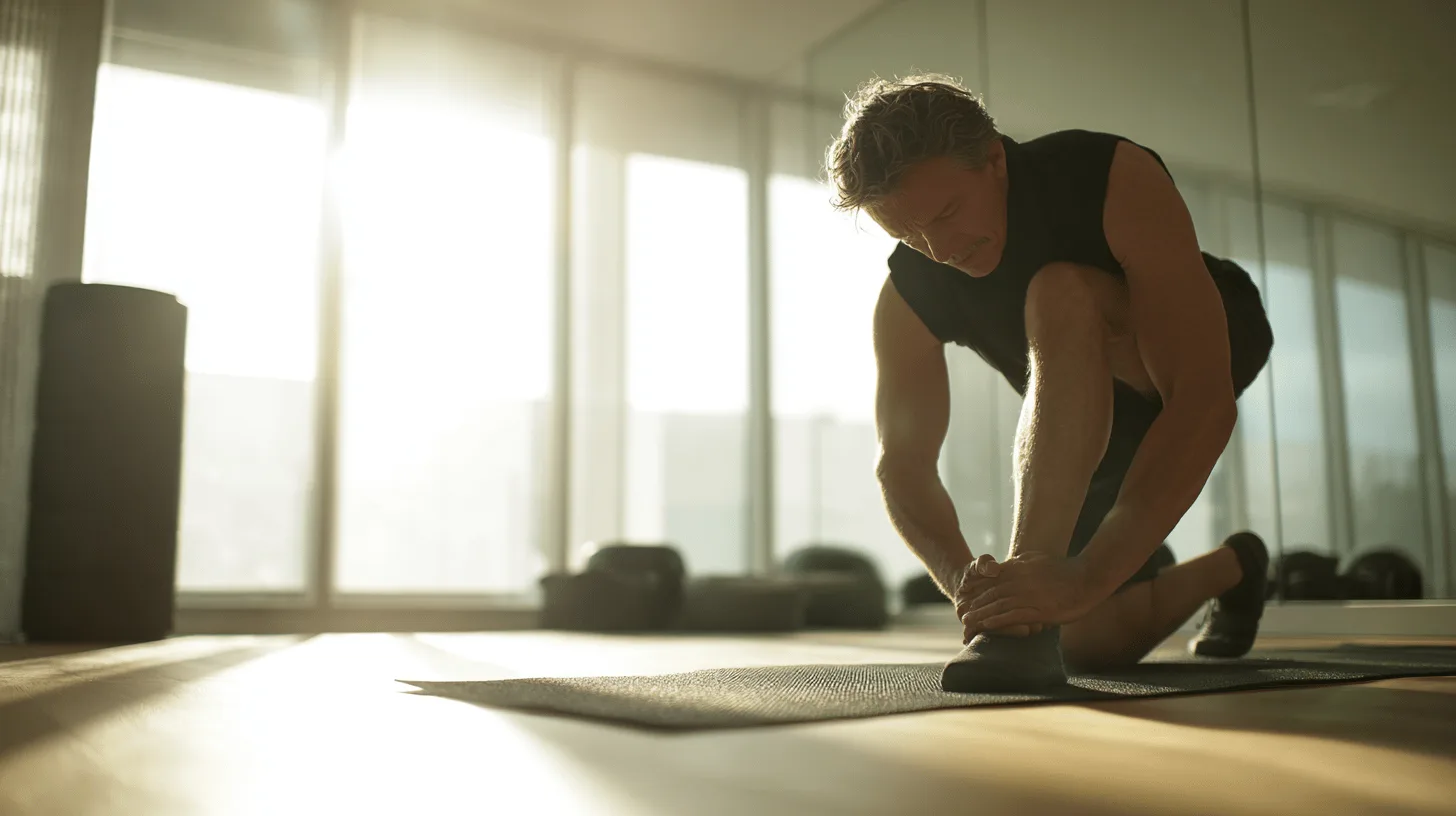
You know the noise. You get out of the car at the gym, and your hips sound like someone stepping on bubble wrap. Then you try an overhead press and your shoulders agree to go about two-thirds of the way.
Plenty of people put this down to age and leave it there. A lot of it is really a use-it-or-lose-it problem, and you can fix that. Ten minutes before you lift is enough to start.

Why do hips and shoulders get stiffer in midlife?
Some of it is biology. Connective tissue gets less springy as you age and joints change. But most of the stiffness men notice in their late 40s and 50s comes from habit. Hours in a chair keep your hips bent and your shoulders rounded forward, and your body adapts to the positions you spend most time in.
The hips and the upper back (the thoracic spine, if you want to impress your physio) usually suffer most. Lose movement there and something else has to make up for it, often your lower back or the front of your shoulder. That is how a perfectly sensible squat or press ends up leaving you sore in places it shouldn’t.
The good news is that the same rule works in your favour. Move through a full range regularly and your body adapts back.
Should you stretch before lifting weights?
Yes, but probably not the way they taught you at school. Holding a long, static stretch just before lifting is no longer the standard advice. Long holds may slightly reduce how much force you can produce for a short while afterwards, although short holds seem to matter little.
What works better is a dynamic warm-up. You move your joints through their range under control, raise your body temperature and rehearse the movements you’re about to load. Then you do a couple of light sets of your first exercise.
There’s also a reason to stop worrying that weights make you muscle-bound. Research suggests that resistance training through a full range of motion improves flexibility about as well as stretching does. That makes the gym part of the fix.
Mobility isn’t a separate hobby. It’s the first ten minutes of your strength session, done properly.

The 10-minute pre-lift routine
Do this in order, moving slowly and breathing normally. Stay in a range that feels like a stretch or effort, never pain.
1. March and swing (1 minute). March on the spot with big arm swings, forwards then across the body. You just want to get warm.
2. Cat-cow (1 minute). On hands and knees, slowly round your back towards the ceiling, then let it sag and lift your chest. Eight to ten slow reps.
3. Open book (2 minutes). Lie on your side with your knees bent to 90 degrees and arms out in front. Sweep the top arm over to the other side, following it with your eyes, then return. Eight reps each side. This is the best thing you can do for a desk-bound upper back.
4. Lunge with a twist (2 minutes). Step into a long lunge, put both hands on the floor inside your front foot, then rotate and reach the inside arm to the ceiling. Five slow reps per side. If your knees object, rest the back knee on a mat.
5. 90/90 hip switches (1 minute). Sit with both knees bent at right angles, one leg in front and one to the side. Rotate both knees over to the other side and back. Use your hands for support at first. This one is humbling.
6. Hip hinge and squat (1 minute). Do eight bodyweight good mornings: hands on hips, push your bottom back with a flat back. Then do eight slow squats to whatever depth you can control.
7. Wall slides (1 minute). Stand with your back to a wall and your arms in a goalpost shape. Slide them up and down while keeping your ribs down and your forearms as close to the wall as you comfortably can.
8. Ramp-up sets (1 minute or so). Do your first exercise with an empty bar or light dumbbells for one or two easy sets before building up to working weight.
The five-minute evening top-up
If you sit all day, a short routine in front of the telly on non-gym days helps more than you’d expect. Here, gentle longer holds are fine, because you aren’t about to lift anything heavy.
Hold a half-kneeling hip flexor stretch for 30 seconds each side, squeezing the glute on the kneeling leg. Spend a minute in child’s pose with your arms reached forward. Finish with ten open books per side and a minute of slow deep breathing lying on your back with your knees bent. That’s it. No kit, no Lycra.
For the bigger picture, the UK Chief Medical Officers’ guidelines say adults should do muscle-strengthening activity on at least two days a week, alongside 150 minutes of moderate activity. If lifting is new to you, a local gym induction is a sensible start. So is the free NHS Couch to 5K plan if you want the cardio side covered too.
What if the stiffness is actually pain?
Stiffness that eases as you warm up is normal. Pain that sharpens, wakes you at night, comes with swelling, or stops you lifting your arm is not something to stretch through.
In England, most adults can now refer themselves to community musculoskeletal (MSK) services, including NHS physiotherapy, without seeing a GP first, though not every area offers this yet. In Scotland, many health boards also take self-referrals. In Wales and Northern Ireland it depends on where you live, so ask your GP surgery. If you don’t know where to start, your GP or pharmacist can point you in the right direction. Call NHS 111 for urgent advice, or 999 if pain comes with chest tightness, breathlessness or a sudden loss of strength.
In short
Midlife stiffness in the hips and shoulders comes mostly from how much you sit, not from age alone, and it responds well to regular movement. Before strength training, swap long static stretches for a ten-minute dynamic warm-up and a couple of light ramp-up sets. Add a short evening routine on rest days, lift through a full range of motion, and see an NHS physiotherapist if stiffness turns into real pain.
Sources

Midcent Health
Adrian Irving writes about health for men 45 and over who would rather do something than worry. Training, weight loss, sleep, cholesterol and blood tests, heart health, testosterone, the prostate, mental health and your sex life – what the evidence says, what's worth trying, and when it's time to see your GP.
One of Midcent's writers. Spotted something? Write to adrian@midcent.uk.