You notice it carrying shopping upstairs: your legs get there, but they lodge a complaint. Or you catch yourself reaching for the wall while putting on a sock. Neither moment means you are destined for a walking stick. They do mean it is worth paying attention.
Staying steady after 50 is less about finding one clever exercise than giving your legs, balance and bones different jobs to do. The encouraging bit is that you can start at home, without buying a machine that will eventually hold the laundry.
How do you keep your legs strong after 50?
Start with what your legs actually do: get you out of a chair, carry you up steps and stop a stumble becoming a fall. Muscle-strengthening work helps preserve those abilities as you get older. NHS guidance for adults aged 19 to 64 recommends working all the major muscle groups on at least two days a week. That includes your back, chest and arms, not just the bits below your belt.
A sturdy, non-wheeled chair makes a sensible starting point. Sit with your feet flat, lean slightly forwards, stand using your legs, then lower yourself slowly. The NHS suggests aiming for five sit-to-stands. Next, hold the chair for support and rise slowly onto your toes for five calf raises. You can add a few mini-squats, bending only as far as feels comfortable. This is training, not an audition for the Olympic weightlifting team.
As those movements become easier, gradually do more or choose a harder version that you can control. Resistance bands, weights and bodyweight exercises give you other options. The NHS describes useful strengthening work as effort that leaves you needing a short rest before repeating it. If you have an injury, a health condition or have not exercised for some time, ask your GP which starting point is suitable.
What actually improves balance?
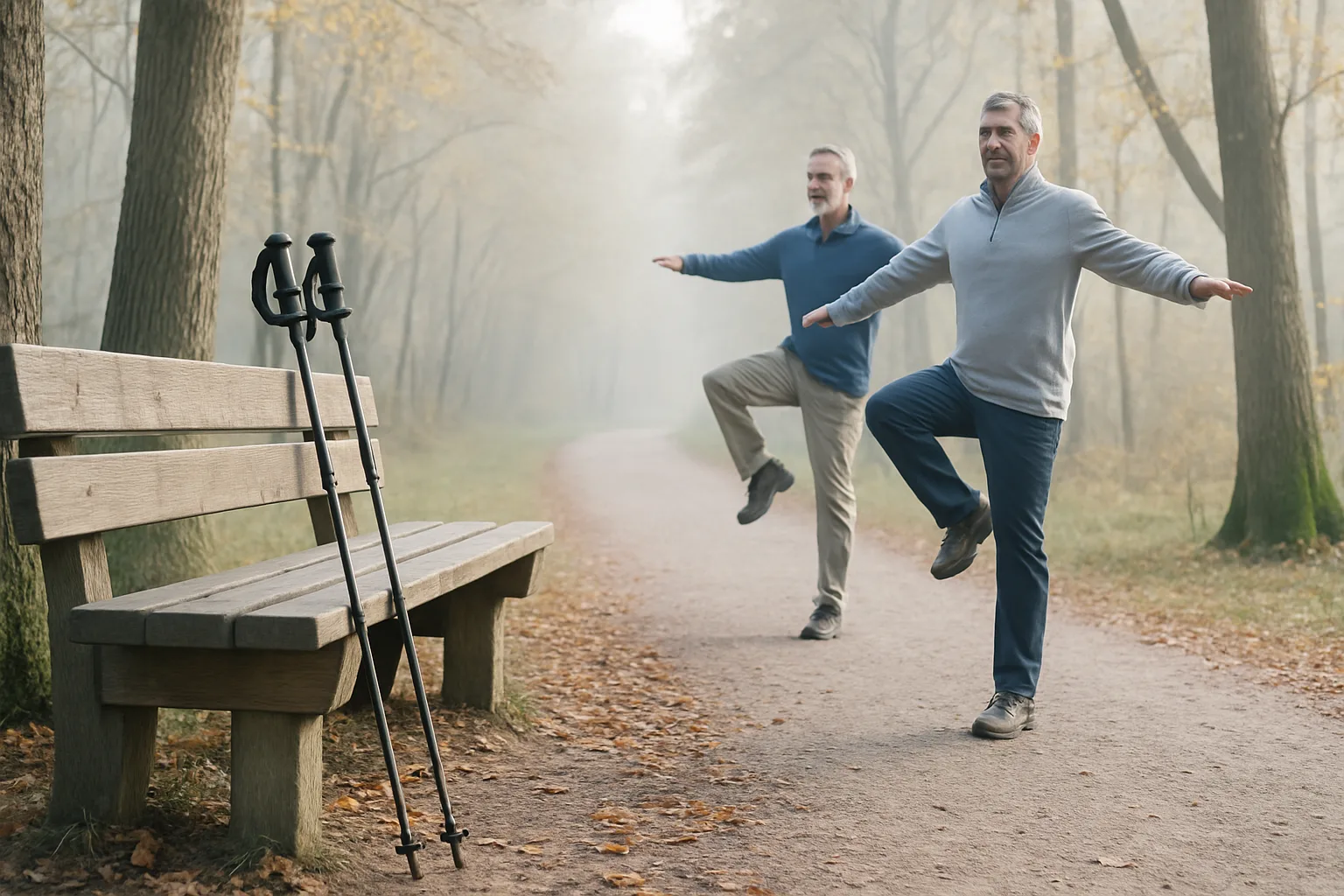
Balance needs practice, not just good intentions. Brisk walking is valuable, but it does not challenge your steadiness in quite the same way as controlled sideways steps or standing briefly on one leg. NHS balance exercises include both, alongside heel-to-toe walking. Try them near a wall or stable chair, with clear floor space and shoes that will not slip.
For a one-leg stand, face the wall with your fingertips against it, lift one foot and keep your hips level. The NHS suggests holding for five to ten seconds and trying three times on each side. Or take slow sideways steps across a room and back. There is no prize for letting go of the wall before you are ready; the point is to practise safely and build up gradually.
Walking keeps you moving. Strength and balance practice help you stay in charge of where you land.
Try pairing balance work with your strengthening days so it becomes a habit rather than another abandoned resolution. If you have already fallen or feel unsteady, do not treat these general exercises as a substitute for an assessment. NICE’s falls guidance covers people aged 50 to 64 who have factors that increase their risk, as well as older adults. Where a falls-prevention programme is needed, it recommends exercise tailored to the person and progressed over time.
Does walking protect your bones?
Walking earns its place. For adults under 65, the NHS recommends at least 150 minutes of moderate activity a week, or 75 minutes of vigorous activity, alongside strengthening work. At a moderate pace, you should be able to talk but not sing. A brisk walk to the shops counts; a gentle wander may still be enjoyable, but it might not reach that intensity.
For your skeleton, think about how the activity loads it. Walking is weight-bearing because your feet support your weight. Resistance exercise also matters for bone health. Swimming and cycling can be excellent ways to get active, but the NHS notes that they are not weight-bearing exercises. You do not need to give up the bike; just avoid asking it to do every job.
Food plays a supporting role. Calcium-containing foods include dairy products, tofu and leafy greens. Vitamin D helps your body absorb calcium, and NHS advice is to consider a daily supplement containing 10 micrograms during autumn and winter. If you rarely go outdoors or have dark skin, NHS advice says a supplement may be worth considering throughout the year. Check with a pharmacist or GP if a health condition affects what you can safely take.
There is an important limit to the supplement pitch: NICE says the evidence is insufficient to recommend vitamin D specifically to prevent falls. Look after your bone and muscle health, certainly. Do not expect a tablet to replace practice getting up, stepping and staying steady.
When is a wobble worth checking?
A trip over a loose cable is a reason to move the cable. Repeated stumbles, a fall, or a new worry about your balance deserve a conversation with your GP. Dizziness, changes in eyesight or hearing, and medicines that make you feel light-headed can all affect steadiness. Ask your GP or pharmacist about possible medicine effects rather than making changes yourself.
Give your home a quick inspection, too. Loose rugs, poor lighting, slippery bathroom floors and shoes that slip off are all fixable hazards. Clear the route to the loo at night, secure trailing wires and consider a non-slip bath mat. These are hardly glamorous upgrades, but neither is explaining to someone how you lost an argument with a rug.
If you have fallen, your GP may check your mobility and consider whether you need help with strength, balance, medicines or hazards at home. Falls services and routes into them vary locally, so ask your GP practice what is available. And if a walking aid has been recommended, use it: the aim is to keep doing things safely, not to win an argument with a stick.
After a fall, use NHS 111 if you may be injured, in pain or unwell. Call 999 if you may have injured your head, back, neck or hip, or cannot get up. For an ordinary training session, stop if an exercise causes pain or makes you feel unwell and seek advice if symptoms persist.
In short
To keep your legs strong and your balance reliable after 50, combine regular walking with strengthening work on at least two days a week and safe balance practice. Build up gradually, support bone health with food and appropriate vitamin D advice, and ask your GP about falls or persistent unsteadiness. A walking aid, if you need one, is a tool for independence, not a failure.
Sources

Midcent Health
Adrian Irving writes about health for men 45 and over who would rather do something than worry. Training, weight loss, sleep, cholesterol and blood tests, heart health, testosterone, the prostate, mental health and your sex life – what the evidence says, what's worth trying, and when it's time to see your GP.
One of Midcent's writers. Spotted something? Write to adrian@midcent.uk.