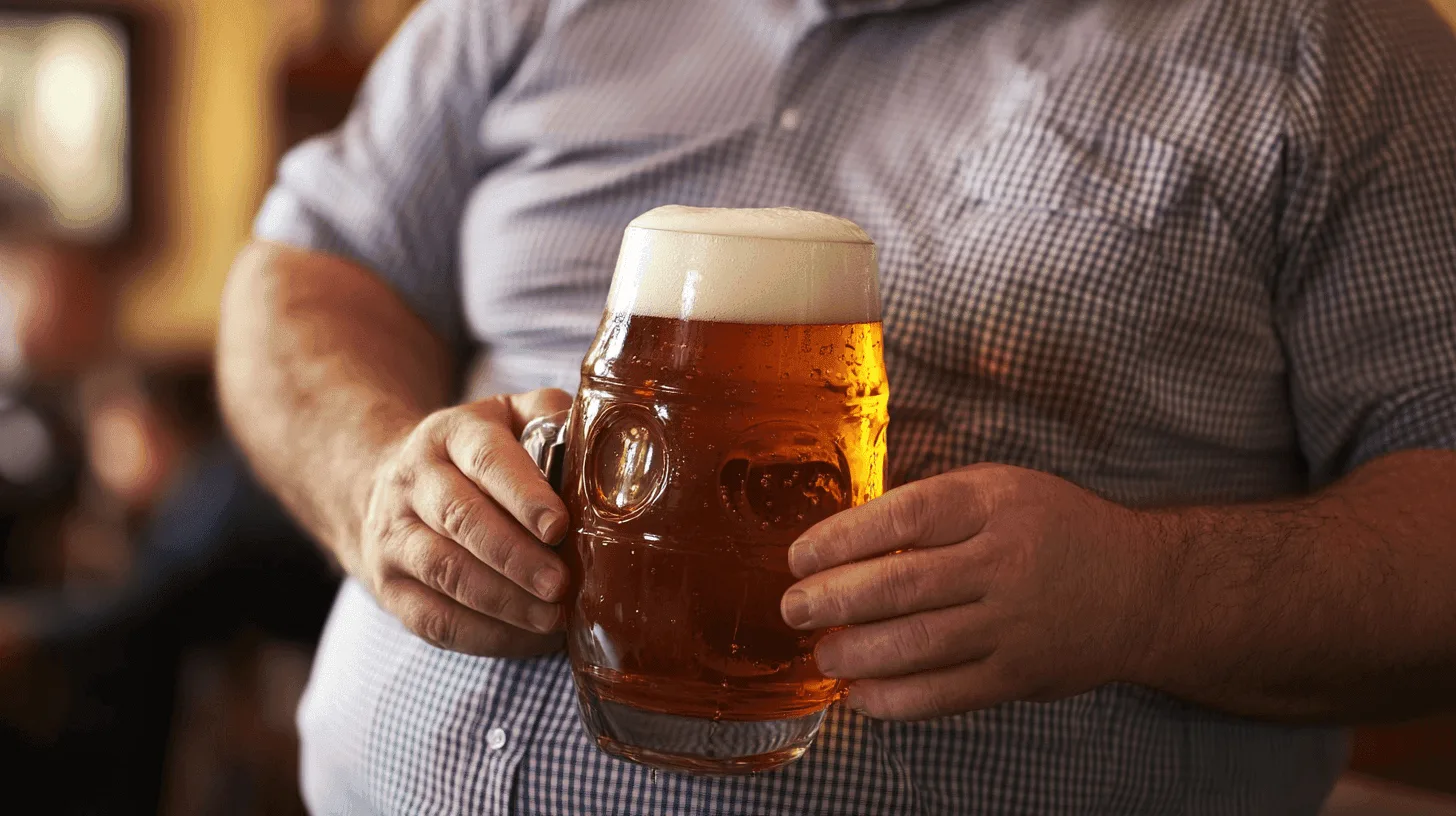
A beer belly isn’t a myth, but beer isn’t the only culprit either. What a pint really costs you in calories, why it settles on your middle, and what to do.
Reviewed, edited and approved by Editor-in-chief Daniel Sköld · Updated 23 October 2026
Contents
There is a moment in most men’s forties when a waistband that used to be on your side quietly changes sides. You haven’t changed much. Same pub, same mates, same three pints on a Friday. Yet something is building up up front, and it isn’t your savings.
The beer belly has a reputation as either a harmless badge of honour or the inevitable price of a social life. It’s neither. Here’s what a pint actually does once it’s inside you, why the extra so often settles round your middle, and how to hold on to the pub without keeping the paunch.
AD
How many calories are in a pint of beer?
More than the label lets on, mainly because there usually isn’t a label. Alcoholic drinks in the UK don’t have to show calories the way a sandwich does, so most of us guess, and we guess low.
NHS figures give a rough guide. A pint of lower-strength lager, beer or cider at around 3.6% ABV comes in at about 170 calories. A pint of something stronger, at about 5.2%, is nearer 222. A 440ml can of 4.5% lager is about 194. Craft IPAs at 6% and up go higher again.
Do the maths on an ordinary weekend. Four pints of a 5.2% lager on Friday and four more on Saturday adds up to roughly 1,780 calories. The NHS guide figure for an average man’s daily intake is 2,500 calories, so that’s most of an extra day’s eating every week. Your stomach doesn’t register any of it as food.
Then there’s the bit that never makes it into the sum: the crisps, the late kebab, the full English the morning after.
Is a beer belly actually caused by beer?
Partly, but not in the way the name suggests. No magic ingredient in beer heads straight for your belly button. Wine, spirits and too many biscuits will do the same thing. Beer is just very good at delivering a lot of calories without filling you up.
A few things work against you at once. First, alcohol is calorie-dense, at about seven calories per gram, nearly as much as fat. Second, your body treats alcohol as a toxin and burns it before anything else, so while it’s busy dealing with your third pint, the fat from your dinner is more likely to be stored than used. Third, alcohol lowers your inhibitions, and a lot of that loosening seems to happen at the bar snacks. Research on whether alcohol directly increases appetite is mixed, but anyone who has eaten a doner at midnight doesn’t need a study to tell them.
Fourth, you’re a man in midlife. Men tend to store extra fat around the abdomen rather than on the hips and thighs, and that tendency grows with age as muscle mass gradually falls and testosterone slowly drifts down. You burn a little less at rest than you did at 30. The pints haven’t changed. You have.
Your body doesn’t care whether the calories came from a pint or a pie. It just cares that it doesn’t have to burn them yet.
Why fat around the middle matters more
Not all fat is equal. The soft layer you can pinch is subcutaneous fat, and it’s relatively harmless. The firm, round belly that pushes your shirt out is more often visceral fat, packed around the liver, gut and other organs.
Visceral fat is metabolically active, which is a polite way of saying it causes trouble. It’s linked to raised blood pressure, higher cholesterol, type 2 diabetes, heart disease and fatty liver disease. Add regular heavy drinking, which is hard on the liver in its own right, and the beer belly starts to look less like a joke and more like a warning sign.
You can measure it with a tape measure. NHS advice is that men with a waist of 94cm (37in) or more have a higher risk of health problems, and the risk rises further above 102cm (40in). NICE also suggests a simple check: your waist should be less than half your height. A 5ft 10in (178cm) man should keep his waist under about 89cm (35in). Measure halfway between your bottom rib and the top of your hip bone, breathe out normally and don’t hold your stomach in. Nobody’s watching.
AD
How do I lose a beer belly without giving up the pub?
The good news is that visceral fat tends to be one of the first things to go when you lose weight. You don’t need to go teetotal or join a boot camp. You need to do the sums differently.
Know your units. The UK Chief Medical Officers’ low-risk guideline is no more than 14 units a week, spread over three or more days, with several drink-free days. That’s about six pints of average-strength beer, not six a night. A pint of strong lager can be close to three units on its own.
Go down in strength, not just in number. Swapping a 5.2% pint for a 3.6% one saves about 50 calories and roughly a unit each time. Alcohol-free beers have improved enormously and are often well under 100 calories a pint, although it’s worth checking the can, as some are surprisingly sugary.
Alternate. A pint of water or a soda with lime between beers slows you down and saves your head in the morning.
Eat before you go, not after. A proper meal beforehand blunts the urge to hoover up crisps, and deciding in advance that there will be no takeaway on the way home removes a few hundred calories in one go.
Move more. You can’t target belly fat with sit-ups, however many you do. Brisk walking, cycling and strength training two or more days a week help you burn more and keep the muscle that midlife is quietly taking away. Losing even 5% of your body weight, about 10lb (4.5kg) for a 14-stone (89kg) man, can make a real difference to your blood pressure and blood sugar.
Try a dry month. Plenty of men find that a few weeks off shows them how much of their weekend eating was really drinking.
When to get it checked
If your waist is over the NHS thresholds, or you’re regularly well over 14 units, it’s worth knowing your numbers. In England, adults aged 40 to 74 without certain existing conditions are invited for a free NHS Health Check every five years, which covers blood pressure, cholesterol, weight and alcohol. Scotland, Wales and Northern Ireland don’t run the same programme, so ask your GP practice or a pharmacy what checks are available where you live.
Talk to your GP if you’re finding it hard to cut down, if drinking is affecting your sleep, mood or relationships, or if you notice symptoms such as yellowing skin or eyes, swelling in your abdomen or unexplained tiredness. For urgent advice that isn’t an emergency, call NHS 111. In an emergency, call 999.
In short
Yes, beer can give you a belly, mainly because a pint carries roughly 170 to 220-plus calories that don’t fill you up, your body burns alcohol before fat, and drinking tends to bring extra food with it. In midlife, men are more likely to store that surplus as harmful visceral fat around the middle. Stay within 14 units a week, choose lower-strength pints, skip the post-pub takeaway and keep your waist below half your height, and the belly usually starts to shrink.
Adrian Irving writes about health for men 45 and over who would rather do something than worry. Training, weight loss, sleep, cholesterol and blood tests, heart health, testosterone, the prostate, mental health and your sex life – what the evidence says, what's worth trying, and when it's time to see your GP.
One of Midcent's writers. Spotted something? Write to adrian@midcent.uk.
Feeling flat, tired and short-tempered in your fifties? Low testosterone is one possible cause, but often not the main one. Here’s how to tell, and how to get tested on the NHS.
Feeling tired, short-tempered and low on energy is easy to put down to age. Sometimes there’s a fixable cause, and a GP blood test will tell you more than a shelf of supplements.
An underactive thyroid can look like ordinary midlife tiredness. Here’s when to ask your GP about a blood test, what the results mean and what treatment involves.