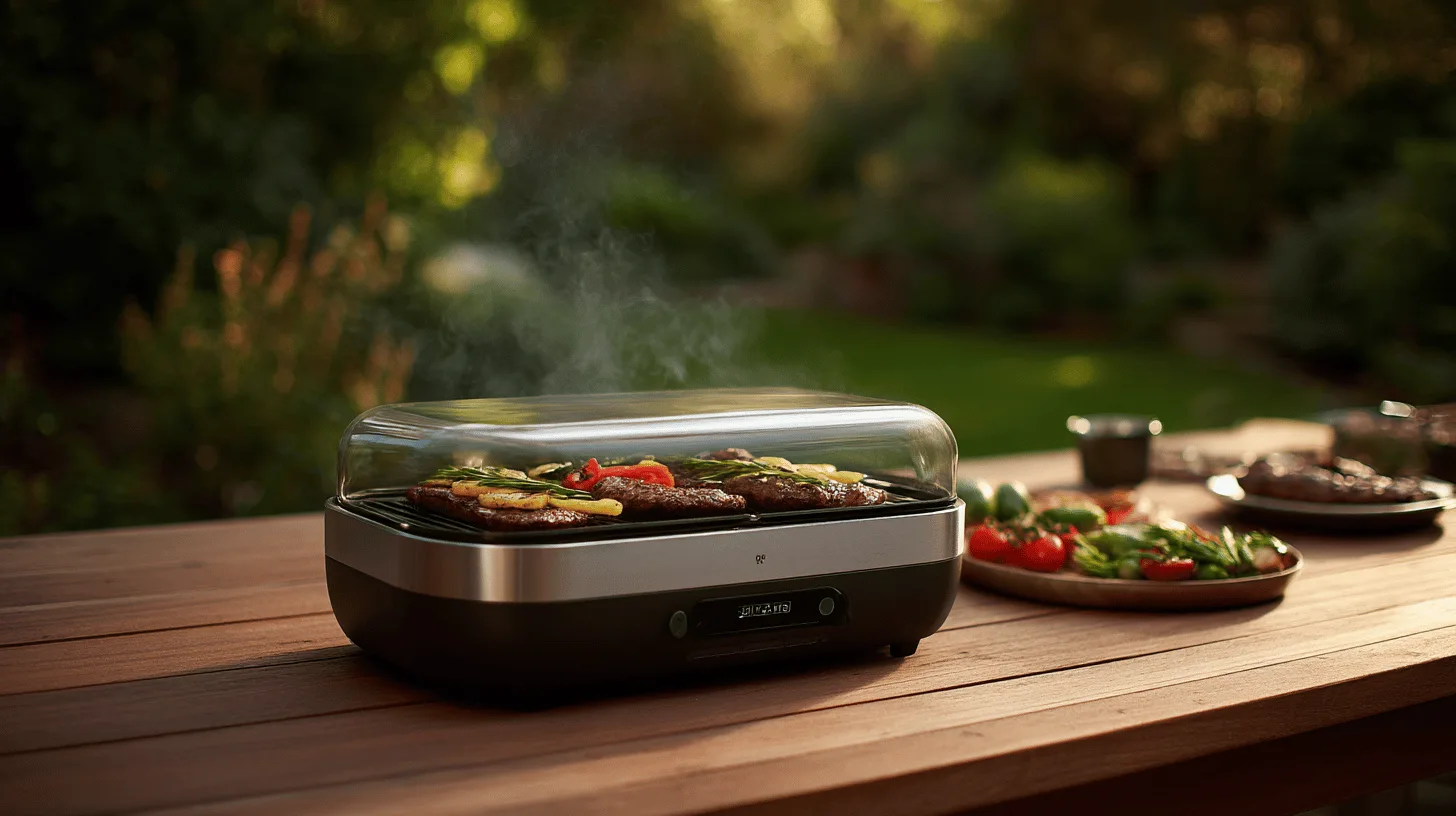
Every British summer has the same moment. Someone stands over the barbecue with tongs, prods a chicken thigh, squints, cuts it open, decides it looks “about right” and puts it back for five more minutes. Just in case. The result: chicken that is safe and as dry as a cream cracker, or sausages charred black outside and worrying inside.
Technology reckons it can fix this. Wireless meat probes, app-controlled grills and Wi-Fi pellet smokers all promise the same thing: you stop guessing and the meat tells you when it’s done. I’ve cooked with enough of them to tell you which bits really help and which are a phone notification with a barbecue attached.

What is a smart meat thermometer and how does it work?
At its simplest, it’s a metal probe you push into the thickest part of the meat. It then sends the internal temperature to an app on your phone. You tell the app what you’re cooking and how you like it, and it buzzes when you get there.
The better ones are completely wireless: the whole probe goes into the meat and the lid comes down on top of it, with no cable trapped in the hinge. Some have a second sensor at the blunt end that reads the air temperature in the grill. With both readings the app can estimate how long you’ve got left, which is the bit that changes your evening. You stop hovering and start talking to your guests.
Most use Bluetooth, the short-range radio your wireless earbuds use. The catch is that a closed metal barbecue is not a friendly place for radio signals, so the range can drop sharply once the lid is down. Pricier models get round this with a base station that relays the signal, or by bridging to your home Wi-Fi so you can check the brisket from the sofa, the shed or the pub over the road. I’d stop short of the pub.
Do you actually need a smart grill?
A smart grill takes the idea further. Instead of just measuring the meat, it controls the heat. The best-known examples are Wi-Fi pellet grills from brands such as Traeger and Weber. They burn compressed wood pellets fed from a hopper by a motor, and a fan and controller hold the temperature you set. From your phone you can change the temperature, watch the probe readings and get a nudge when the hopper is running low.
For slow cooking, this really is good. Holding a steady 110°C for ten hours used to mean getting up at 3am to fiddle with charcoal vents. A pellet grill does it while you sleep. If pulled pork, brisket or smoked ribs are your thing, it earns its keep.
For burgers, sausages and the odd steak on a Saturday, it’s overkill. These are big, heavy machines that need mains power, a supply of pellets and some cleaning, and they cost several times as much as a decent kettle barbecue. A good charcoal or gas grill with a separate wireless probe gets you 90 per cent of the benefit for a fraction of the outlay.
The clever part isn’t the grill. It’s knowing the temperature in the middle of the meat, and you can buy that for the price of a takeaway.
What temperature should barbecued meat be in the UK?
This is where a thermometer goes from toy to tool. The Food Standards Agency’s benchmark for killing harmful bacteria is a core temperature of 75°C for 30 seconds, or an equivalent combination such as 70°C held for two minutes. That applies to anything that needs cooking all the way through: chicken, turkey, burgers, sausages, kebabs and pork.
Burgers and sausages matter most, because mincing spreads any bacteria from the surface right through the meat. A steak is different. The bugs sit mainly on the outside, so a whole cut of beef or lamb that is well seared outside can be served pink in the middle. For steak, as a rough guide, cooks aim for about 50°C for rare, 55 to 57°C for medium-rare and around 60°C for medium, before resting.
Resting is the other thing the good apps handle well. Meat keeps cooking after it comes off the heat, and a thick joint can rise several degrees. Decent apps factor this in and tell you to take it off a little early. That’s the difference between the medium-rare you wanted and the medium you got.
One practical point: put the probe in the thickest part, away from bone, because bone conducts heat and will flatter the reading. And if you’re cooking for older relatives, anyone pregnant or small children, play safe and cook to the full 75°C.
Is a connected barbecue a security risk?
In fairness, nobody is going to hack your sausages. But anything that joins your home Wi-Fi is another device on your network, and cheap, badly made gadgets have a long history of weak security.
The good news is that UK law now helps. Since 29 April 2024, the product security regime under the Product Security and Telecommunications Infrastructure Act has applied to connectable consumer products sold here. Makers can’t ship devices with easy-to-guess default passwords, must give you a way to report security flaws and must say how long the product will get security updates. Check that last point before you buy. A grill you expect to last ten years shouldn’t stop getting updates after two.
Also think about what happens if the company loses interest. A Bluetooth probe that works with a simple app is fairly future-proof. A grill whose main controls depend on a cloud service is only as good as that service. Ideally the grill still works properly from its own control panel when the app or the internet doesn’t.
Which one is worth your money?
Here’s my blunt ranking. If you barbecue a handful of times a summer, buy a basic instant-read digital thermometer. You can get one for under £20. It isn’t smart and it doesn’t need to be. Stab, read, done.
If you cook bigger joints, roast chickens or anything that takes longer than 20 minutes, a fully wireless probe is the sweet spot. Expect to pay from around £50 to well over £100, depending on range, number of probes and whether it can connect over Wi-Fi. The time estimates alone make it worth it, and it works just as well in the kitchen oven on a wet Sunday in November. In Britain, that’s most Sundays.
A Wi-Fi pellet grill is for the enthusiast who wants low-and-slow smoking without the all-nighter. It’s brilliant at that job and expensive for anything else. Before you spend, check the battery life and charging method, whether the probe can go in the dishwasher, how many probes you can run at once, and the update period the maker promises.

In short
Smart barbecue kit really does take the guesswork out, but the useful part is knowing the core temperature, not having Wi-Fi in the grill. For most people a wireless meat probe is the best buy: aim for 75°C for 30 seconds (or the equivalent) in chicken, pork, burgers and sausages, and leave app-controlled pellet grills to dedicated slow-cooking fans. Whatever you buy, check how long the maker promises security updates, which UK law now requires them to tell you.
Sources

Midcent Tech
Alex Innes explains technology for men 45 and over who have seen every gadget since the ZX Spectrum and are not easily impressed. AI and ChatGPT, phones, cars, the smart home, the subscriptions worth keeping and staying safe online – what it does, whether it's worth the money, and whether you need it at all.
One of Midcent's writers. Spotted something? Write to alex@midcent.uk.