Loud snoring with pauses and gasps can be a sign of obstructive sleep apnoea. Here’s what it does to your body, how the NHS tests for it and how it’s treated.
Reviewed, edited and approved by Editor-in-chief Daniel Sköld · Updated 23 October 2026
Contents
Most snoring is just noise. It annoys whoever sleeps next to you, gets you banished to the spare room and gives the family a story for Christmas. Some snoring is a symptom, though, and it tends to show up in men just like you: over 40, a bit wider round the middle and the neck than you used to be, and fond of a nightcap.
It’s called obstructive sleep apnoea. Your breathing keeps stopping while you sleep, and you’ll almost certainly have no memory of it in the morning. The good news is that it’s easy to test for, the NHS treats it and the treatment works. All you have to do is stop shrugging it off.
AD
What is sleep apnoea, and how is it different from ordinary snoring?
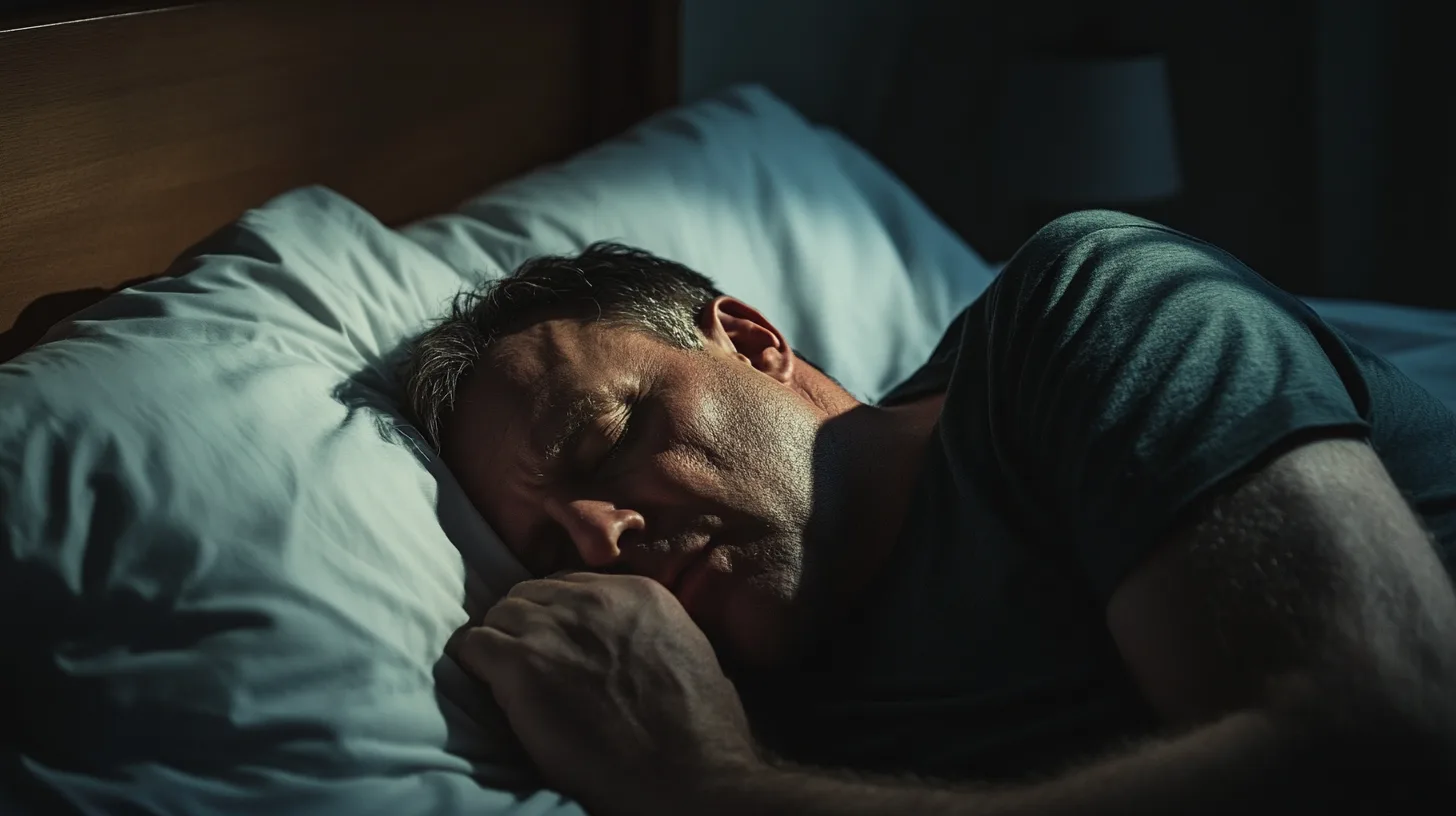
When you sleep, the muscles and soft tissue in your throat relax. In most people that just narrows the airway, the air rattles past and you get snoring. In obstructive sleep apnoea (OSA), the airway closes partly or completely, sometimes again and again throughout the night.
Your brain notices the oxygen dropping and pulls you out of deep sleep just far enough to open the airway again. You snort, gasp or grunt, start breathing and drift off. Then it happens again. You don’t remember any of it, so you wake up thinking you’ve had a full night and can’t work out why you feel so rough.
That’s the key difference. Ordinary snoring is a noise. Sleep apnoea means your sleep keeps getting broken up and your body keeps running short of oxygen, night after night.
The signs your partner notices before you do
Your partner is usually the one who spots it first. NHS guidance lists the main night-time signs as:
Loud snoring. Noisy or laboured breathing. Pauses in breathing that end with a gasp, snort or choke. Waking often to go to the loo. Night sweats.
The daytime signs are things you can check yourself. Do you feel very sleepy during the day? Do you nod off in front of the telly, in meetings or as a passenger? NHS sleep services also list morning headaches, poor concentration, a patchy memory, irritability and low sex drive or erection problems. Plenty of men put all of that down to age, work or kids who still won’t leave home.
The risk goes up if you’re overweight (especially if your collar is about 17 inches or more), if you drink alcohol in the evening, if you smoke or if you take sedatives or sleeping tablets. Being male and middle-aged doesn’t help either. You can’t change your age, but most of the others are worth knowing about.
Is sleep apnoea dangerous?
It can be, and in two quite different ways.
The first is your heart and blood vessels. Every pause in your breathing sends your oxygen down and your heart rate and blood pressure up as your body jolts back awake. Do that hundreds of times a night for years and the strain adds up. Untreated OSA is linked to high blood pressure, irregular heart rhythms, heart attack and stroke. The British Heart Foundation has funded research into why people with sleep apnoea are more likely to die of heart disease, which tells you cardiologists take it seriously. Researchers are still working out exactly how much of the link is caused by the apnoea itself and how much comes from things that go with it, like weight. Either way, it’s not a link to ignore.
The second is more immediate: falling asleep at the wheel. A wrecked night followed by the M6 is a bad combination. Even if you never fully nod off, a sleepy brain reacts more slowly.
Snoring is a noise. Stopping breathing 30 times an hour is a medical problem.
That brings us to driving rules. In England, Scotland and Wales, the DVLA says you must tell it if you have obstructive sleep apnoea that causes excessive daytime sleepiness, or if you’re very sleepy during the day because of any medical condition. In Northern Ireland you tell the DVA. You can be fined up to £1,000 if you don’t declare a condition that affects your driving.
Don’t let that put you off getting checked. Plenty of people with OSA aren’t sleepy enough to have to declare it, and most people who are treated carry on driving once their symptoms are under control. Your sleep specialist will tell you whether and when you need to inform the DVLA. One rule applies to everyone, diagnosis or not: if you feel sleepy, don’t drive.
AD
How do I get tested for sleep apnoea on the NHS?
Start with your GP. They’ll ask about your symptoms (bring your partner’s eyewitness account if you can) and will probably use a short questionnaire such as the Epworth Sleepiness Scale. That asks how likely you are to doze off in everyday situations, like sitting in traffic or after lunch. NICE guidance also suggests tools like the STOP-Bang questionnaire, which asks about snoring, tiredness, observed pauses, blood pressure, weight, age, neck size and sex.
If it looks likely, you’ll be referred to a sleep service. These days, the first test is usually done at home. You take a small kit home and wear it for a night or two. It records your breathing, oxygen levels and heart rate while you sleep in your own bed. Some people need an overnight stay in a sleep centre instead. The results show how many times an hour your breathing stops or gets shallow, which tells the specialist whether your OSA is mild, moderate or severe.
While you’re with your GP, ask about your blood pressure. If you’re 40 to 74 and live in England, you can also get a free NHS Health Check, which looks at heart and stroke risk. Scotland, Wales and Northern Ireland don’t have an identical scheme, so ask your GP practice or a pharmacist what’s offered locally.
The fixes, from the free to the faintly ridiculous-looking
For moderate or severe OSA, the main treatment is CPAP (continuous positive airway pressure). You wear a mask that gently blows air into your airway all night to keep it open. It’s supplied through NHS sleep services, and NICE recommends it for people whose sleep apnoea is getting in the way of daily life.
CPAP doesn’t look great in bed. Darth Vader comparisons will be made. But many users say the first morning after a properly unbroken night is a revelation. Getting used to it takes some trial and error. If it isn’t working for you, tell the sleep team rather than leaving it in a drawer. A different mask, heated humidification for a dry or blocked nose, or a machine that adjusts the pressure automatically can all make it easier to live with.
For milder cases, or if you can’t get on with CPAP, a mandibular advancement device may help. It’s a gum-shield-style splint that holds your lower jaw and tongue forward to widen the airway. NHS Inform recommends having one made by a dentist trained in treating sleep apnoea rather than buying a generic one online. Surgery is an option for a small number of people, usually when there’s a specific blockage such as large tonsils.
Then there’s the bit you can do yourself, which the NHS recommends alongside any treatment:
Lose weight if you’re carrying extra. Even a stone (6.4kg) can make a noticeable difference for some people, because fat around the neck squeezes the airway. Cut down on alcohol, especially in the evening, because it relaxes your throat muscles even more. Stop smoking. Sleep on your side rather than your back. And if you take sleeping tablets or sedatives, ask your GP or pharmacist whether they could be making things worse. Don’t stop any prescribed medicine on your own.
As for the gadgets: anti-snoring nasal strips, sprays and smartwatch sleep scores might help with simple snoring or give you a hint that something’s off. None of them can diagnose or treat sleep apnoea. If your watch says your oxygen dips every night, take that to your GP and get a proper test.
In short
Loud snoring with pauses, gasps and daytime sleepiness can be a sign of obstructive sleep apnoea, which is linked to high blood pressure, heart problems, stroke and accidents on the road. It’s common in middle-aged men, especially if you’re overweight, drink in the evening or smoke. See your GP: testing is usually done at home, and treatments such as CPAP work well. If you’re sleepy during the day, don’t drive until you’ve been checked, and contact NHS 111 or 999 if someone has serious trouble breathing.
Adrian Irving writes about health for men 45 and over who would rather do something than worry. Training, weight loss, sleep, cholesterol and blood tests, heart health, testosterone, the prostate, mental health and your sex life – what the evidence says, what's worth trying, and when it's time to see your GP.
One of Midcent's writers. Spotted something? Write to adrian@midcent.uk.
An underactive thyroid can look like ordinary midlife tiredness. Here’s when to ask your GP about a blood test, what the results mean and what treatment involves.
Short nights, loud snoring and 3am wake-ups can all push your blood pressure up. Here is what the evidence says, which signs matter and what to do about them.
Constipation, a quiet appetite, muscle you didn’t mean to lose and weight that can come back. The parts of life on semaglutide that rarely make the before-and-after photos.