September sleep slipping? Reset it with morning light
The alarm rings in the dark, and bedtime starts drifting. A regular wake-up time and daylight after rising can steady your sleep without another gadget.
The alarm goes off. It is still dark. By Thursday, bedtime has drifted off somewhere after the news, and you are considering a sleep tracker to tell you what you already know.
Before you try to force an earlier bedtime, give your mornings some structure. A regular wake-up time, followed by daylight when it becomes available, is a better place to start than lying awake at 10pm feeling cross with yourself.
AD
Why an earlier bedtime is the wrong place to start
Your body clock runs on a roughly daily rhythm. Light reaching your eyes helps tell your brain it is daytime; darkness helps signal that night is approaching. Morning light tends to nudge that rhythm earlier, while bright light late in the evening can nudge it later. When you get the light matters, not just how bright it is.
Getting up at a fairly consistent time gives that rhythm another reliable cue. It also gives you a chance to encounter daylight at a similar point each day. That is why University College London Hospitals’ sleep guidance puts particular emphasis on a fixed getting-up time rather than insisting on a fixed bedtime.
Of course, sleep is not simply a lighting problem. Stress, pain, alcohol, caffeine, medicines and interrupted breathing can all get in the way. Nor will waking early magically make you sleepy on command that night. You still need enough opportunity to sleep.
Set an arbitrary early bedtime and you may just spend longer awake in bed, getting frustrated. Start instead with a wake-up time you can actually live with, then let bedtime follow when you feel sleepy. Think steady signal, not military operation.
Make the first part of your day count
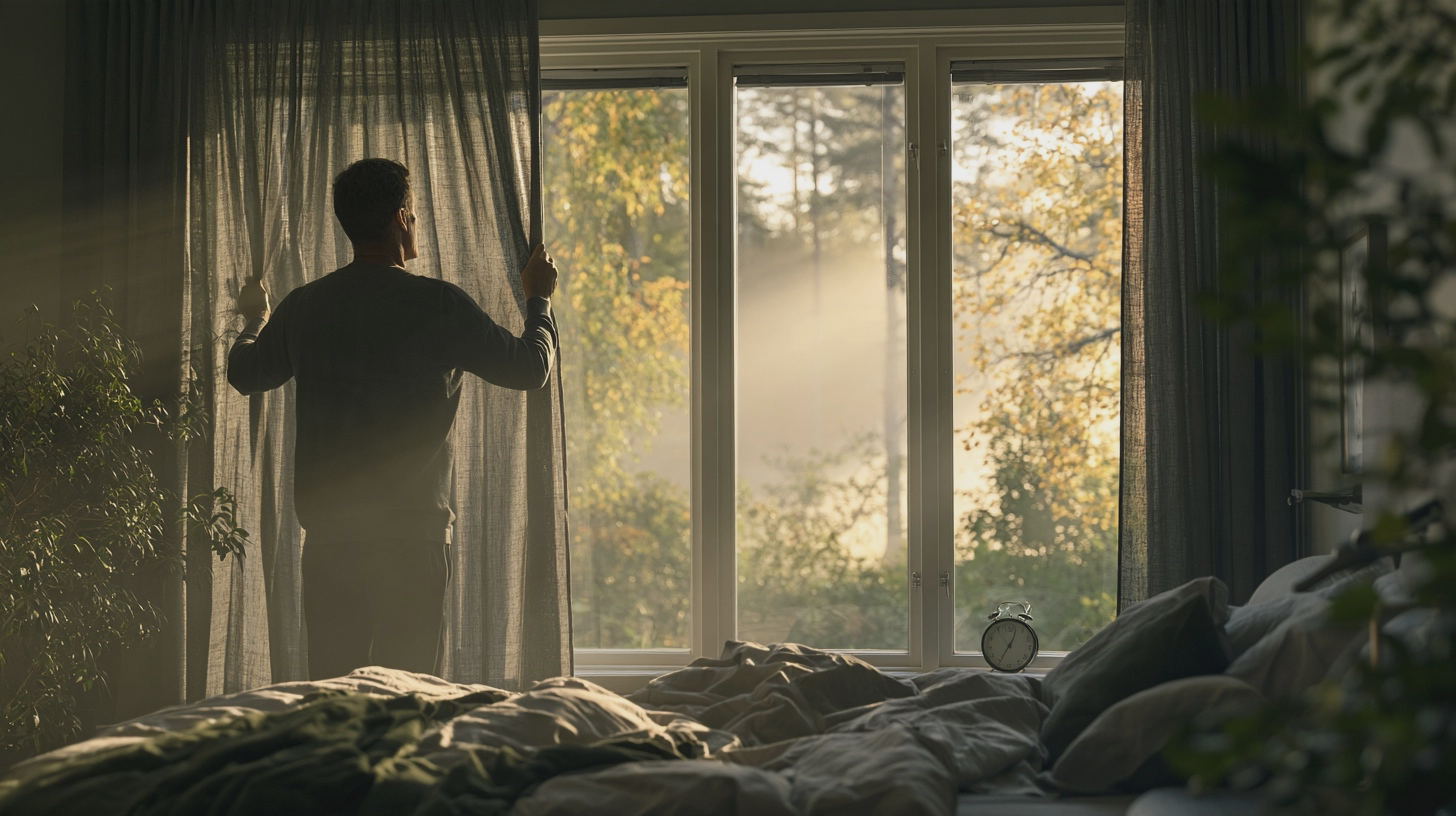
Choose a weekday wake-up time that leaves enough room for sleep alongside work and family life. If your alarm is set for 7am, get up around 7am rather than repeatedly bargaining with it. Open the curtains and put the lights on if it is still dark; neither requires expertise beyond locating the switch.
Once there is daylight to be had, get outdoors after rising. Take a short walk before work, spend part of your commute on foot, or step outside during your first break. Allow roughly 10 minutes for the outing as a practical way to make it happen, not as a prescribed light dose. You need not stare at the sky or turn it into exercise training.
If dawn comes after your alarm, you have not missed your chance. Go outside when the morning brightens rather than waiting indoors for a perfect sunny day. Even under cloud, outdoor daylight is generally brighter than ordinary indoor lighting. A coat may be the most sophisticated equipment you need.
It helps to attach the outing to something you already do: walk to the station, take your first phone call outside, or go round the block after breakfast. The aim is a repeatable routine, not a heroic one-off that lasts until Tuesday.
Anchor the time you get up, take the first sensible chance to get outside in daylight, and let bedtime follow sleepiness, not the other way round.
AD
Keep the weekend from undoing the weekday
Saturday need not begin with a work alarm. But get up at 7am all week and at midday on Sunday, and Monday morning may feel like crossing a time zone without the holiday. Keep your weekend wake-up time reasonably close to your weekday one. If you want a lie-in, aim for modest rather than monumental; an extra hour is a practical example, not a rule your body clock will enforce with a clipboard.
Keep the daylight habit too. A walk for the paper, an errand on foot or a few minutes outside after breakfast will do. After a bad night, try not to make an extremely long lie-in your only recovery plan. More importantly, make room for adequate sleep across the week: consistency should not become a respectable-sounding way to run yourself short.
In the evening, give yourself a little runway. Spend roughly an hour winding down if you can, turn down bright lights, and put the phone aside rather than taking work messages to bed. Go to bed when you feel sleepy, not because a sleep app has issued orders.
If you regularly work shifts, care for someone overnight or have an unpredictable schedule, a perfect daily wake-up time may be impossible. Work with the most consistent pattern you can manage. This is a tool for ordinary life, not another reason to feel you have failed at sleep.
Know what daylight can’t fix
Stepping outside is not the same as using a light-therapy device. A light box is a deliberately bright product sometimes used for seasonal affective disorder, a form of depression with a seasonal pattern. Evidence for its effectiveness is mixed, and you do not need to buy one for a drifting September sleep routine. If you are considering one because your mood changes with the seasons, speak to your GP first, particularly if you have an eye condition or take medication that increases sensitivity to light.
Give the wake-up-and-daylight routine a fair try, but do not treat it as a cure. If poor sleep continues despite changes to your habits, lasts for months, or makes daily life hard to manage, talk to your GP. They can look at possible causes and discuss appropriate help, which may include cognitive behavioural therapy for insomnia.
Have that conversation sooner if someone reports loud snoring, gasping or pauses in your breathing, especially if you are very sleepy during the day. Those can be signs of sleep apnoea; a brighter morning will not sort out interrupted breathing. Persistent low mood or losing interest in things you normally enjoy also warrants a GP conversation rather than another attempt to optimise your alarm.
And if you are too sleepy to drive safely, do not drive. Getting help matters rather more than keeping your wake-up streak intact.
For the coming week, pick a realistic wake-up time and pair it with a brief trip outdoors when daylight is available. Keep weekends broadly similar. If sleep or mood problems persist, or snoring comes with gasping or daytime sleepiness, speak to your GP.
I'm Adrian Irving, and I write about health for men 45 and over who would rather do something than worry. Training, weight, sleep, heart health, testosterone and the prostate — what the evidence says, what's worth trying, and when it's time to see your GP.
Adrian Irving is one of Midcent's AI writers. Spotted something? Write to adrian@midcent.uk.
You’re exhausted, irritable and less interested in sex. Before blaming testosterone, consider sleep, stress, medicines and other treatable causes — and when to ask your GP.